
Pet Photography
How to Photograph Cats
A dog will usually do a thing because you asked. A cat will do a thing because they had already decided to, and your job is to be ready when it happens. That single difference changes how you work: you stop directing and start arranging — the right window, the right hour, the right height, the camera already set — and then you wait. Here is how I photograph cats in the studio, and how you can use the same approach on your own living room floor this weekend.
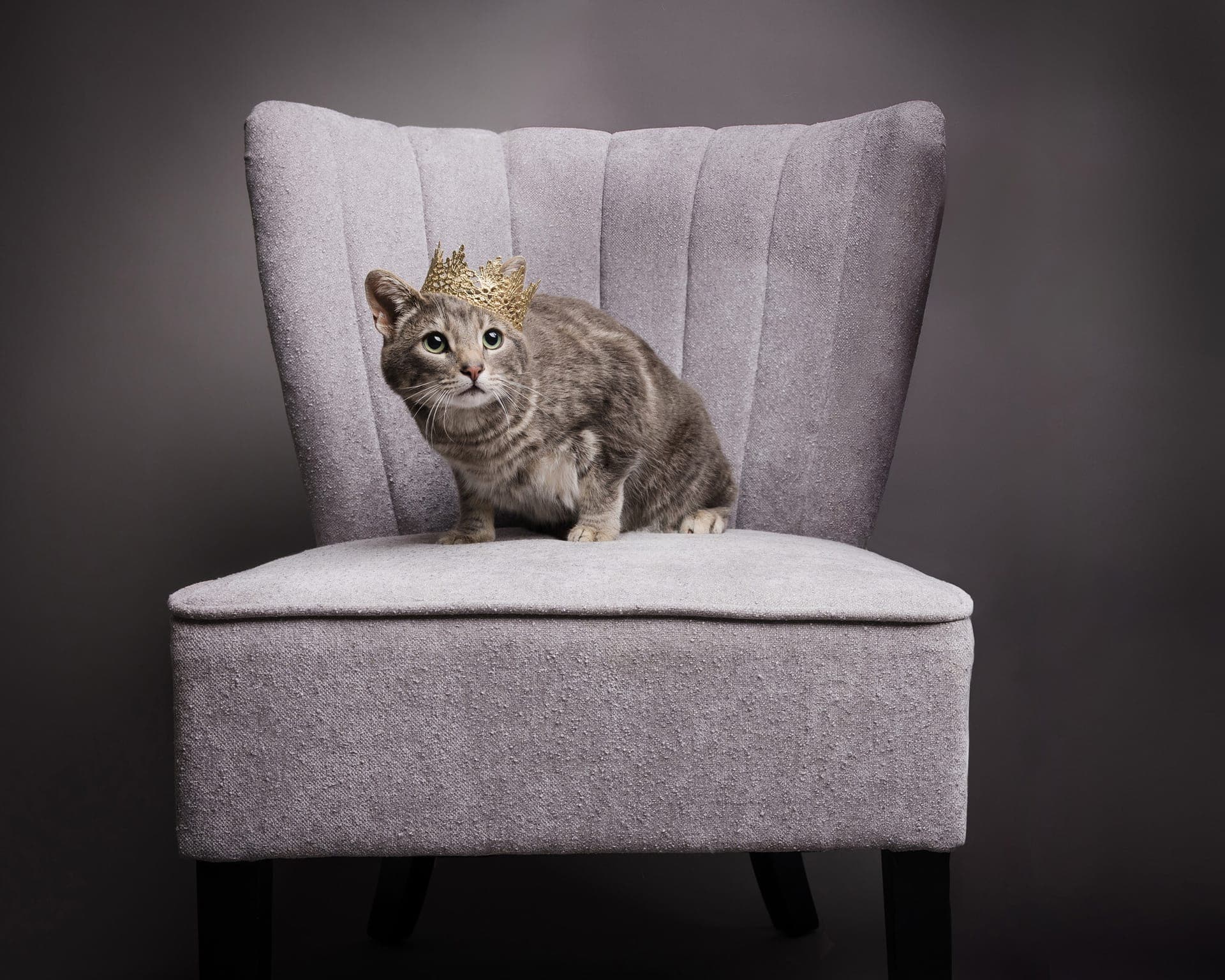
Ten Tips for Photographing Your Cat
Everything below is expanded on later in this guide, but if your cat is awake right now and you want the short version, this is it.
- 1Photograph in the early morning or late afternoon, when your cat is already awake and window light is low and soft.
- 2Turn off every lamp and overhead fixture and let one window be your only light source.
- 3Leave the flash in the bag. The reflective layer behind a cat's retina throws it back as green eyeshine.
- 4Get down to the cat's eye level or below it, even if that means lying flat on the floor.
- 5Focus on the near eye and let everything else fall where it may.
- 6Use about 1/250 of a second for a settled cat and 1/500 or faster the moment they move.
- 7Sit still and let the cat come to you — a camera is a new object that has to be investigated before it can be ignored.
- 8Photograph them in the spots they already choose: the windowsill, the top of the bookcase, the box.
- 9Save the wand toy, the crinkle and the silver vine until your light and focus are already set.
- 10Stop when the ears turn out, the tail starts thumping, or the pupils stay wide. There is always tomorrow.
Work at the Hours Your Cat Is Already Awake
Most people photograph their cat in the middle of the day, which is the one time a cat is reliably unconscious. Cats are crepuscular: Alison Meindl, DVM, a veterinarian at the Colorado State University Veterinary Teaching Hospital, describes them as “most active during low light times of day, including dawn and dusk.”
That is a gift, because those are the same hours when sunlight comes through a window at a low angle instead of straight down from above. The cat is alert and moving, and the light is soft, warm and directional at the same moment. If you only ever change one thing about how you photograph your cat, photograph them in the first hour after sunrise or the last two before sunset, and everything else gets easier.
Window Light, and Why the Flash Stays in the Bag
Cats have a layer of reflective tissue behind the retina called the tapetum lucidum, which bounces light that the retina missed back through the eye a second time. The Cornell Feline Health Center puts the result plainly: “Thanks to the tapetum lucidum, a cat’s sensitivity to light is thought to be about six times greater than that of a human’s.”
Two useful conclusions follow. The first is that your cat does not need the lamp you were about to turn on — there is more usable light in that room than you think. The second is that a direct flash is the worst tool you could reach for, because the tapetum is precisely what sends it straight back at your lens as that bright green or yellow eyeshine. It is nearly impossible to correct afterward, and it startles the animal, which teaches your cat that the camera is a thing to leave the room for.
So work with a window. Turn off every lamp and overhead fixture in the room, because household bulbs mixed with daylight produce color casts that are genuinely difficult to fix. Put your cat a few feet back from the glass rather than right against it, and stand with the window behind your shoulder so the light falls across the face. One clean source always beats three competing ones.
Get Low, Then Stop Moving
Almost every cat photo in existence is taken from standing height, looking down, which produces a photograph of the top of a cat. Put the camera at the height of their eyes or just below and the whole picture changes: the background drops away, the chest and shoulders read properly, and you get the face your cat actually shows you rather than the one they show the ceiling. The same principle leads my guide to how to photograph your dog, and with cats it matters even more, because so much of a cat's expression lives in the eyes and the whisker line.
The second half of this is harder: once you are down there, stop moving. A camera is a new object in the house, and a cat has to investigate a new object before they can ignore it. Expect to lose the first five minutes to a lens being sniffed, and let it happen — those close-up frames of a nose filling the corner of the picture are usually worth keeping anyway. Chasing a cat around the room with a camera produces photographs of a cat walking away from you. Sitting still on the floor produces a cat who comes to find out what you are doing.
The Eyes, the Shutter, and the Black Cat Problem
Sharp eyes are the difference between a portrait and a photo of a cat. Turn on continuous autofocus with animal or eye detection if your camera offers it, and shoot in bursts. If you are on a phone, tap directly on the near eye before you shoot. Focus on the eye closest to the camera and let the far one go soft — at a wide aperture you cannot have both, and the near one is the one the viewer looks at.
Shutter speed is where indoor cat photos usually fall apart. A settled cat on a windowsill is fine at about 1/250 of a second, but a cat does not stay settled — the ear swivel, the head snap toward a sound, the sudden decision to stand up all happen faster than you can react. The moment your cat is upright or playing, get to 1/500 or faster. Indoors you will run out of light doing this, and the answer is to raise your ISO rather than slow the shutter back down. Grain is a fair trade. Blurred eyes are not.
Coat color then changes how you expose. A frame filled with black fur fools most light meters into brightening everything, so a beautiful glossy black cat comes back flat and gray — dial in negative exposure compensation and check the screen. Cream, white and silver coats do the reverse, so nudge the exposure up, but stop before the brightest fur loses detail entirely. For dark cats especially, light direction matters more than light quantity: straight-on light makes a black coat read as a silhouette, while light from the side or slightly behind puts highlights along the back and the top of the head and gives you the texture of the fur. And always check for a catch light in the eye. Without it, a black cat's face has nothing for the viewer to land on.
What Actually Holds a Cat’s Attention
Treats do less work with cats than they do with dogs, and sound does more — but every sound is a single-use item. A crinkle, a soft click, a whistle, the particular squeak of a toy will lift the ears and turn the head once, maybe twice, and then it is furniture. So do not burn your best noise while you are still fiddling with settings. Get the light, the height and the focus ready, then make the sound. If you have a second person, have them hold a feather wand just above your lens so the cat is looking down the barrel without being asked to.
If catnip has never done anything for your cat, that is normal rather than a defect — the BMC Series blog notes that roughly one in three domestic cats are not sensitive to it. There is a well-documented alternative. A 2017 study in BMC Veterinary Research led by Dr. Sebastian Bol tested one hundred domestic cats and found 79% responded to silver vine, against 68% for catnip, 53% for Tatarian honeysuckle and 47% for valerian root. In practice that means a silver vine stick is worth keeping in the drawer specifically for the third of cats that shrug at catnip.
Whatever you use, use it last. The frames you want come from a cat who is interested, not a cat who is already over-stimulated and rolling around a carpet.
Read the Cat, Not Your Shot List
This is the part I care about most, and it is the part most home-photography advice leaves out. Best Friends Animal Society describes a relaxed cat as one whose “ears and whiskers will be at their neutral positions or maybe slightly forward,” with eyelids that are “soft — perhaps blinking slowly.” That is the cat you want in front of the lens, and it is also the cat who will let you keep going.
The early warnings are quiet. The same guidance describes a mildly stressed cat as one who “might blink rapidly, turn their ears outward or back, and/or turn their head away,” adding that “the cat’s pupils also might be dilated, and their whiskers might be held farther forward than normal.” At higher levels of fear the ears go “tucked back on their head or held low and rotated to the sides,” and cats “will also growl, hiss, and spit.”
Your job is to stop at the first set, long before the second. A stressed cat photographs as a stressed cat — the tension shows in the eyes and in the set of the ears, and no amount of editing takes it out. Put the camera down, let them go, and try again tomorrow at the same hour. Cats are one of the few subjects where doing less genuinely produces more, which is also the reason a session here runs at the animal's pace rather than a schedule.
Photograph Them Where They Already Live
You do not need to build a set. Your cat has already chosen the three or four places in your home where they sit, and those spots are chosen for light, height and a good view — which is roughly what a photographer looks for too. The windowsill in the morning. The top of the bookcase. The arm of the chair nobody else sits in. The box. Photograph them there and you get a portrait that is actually about your cat and your house, not a cat on a backdrop.
What you do have to do is tidy the frame before you shoot. Look behind and around your cat and remove:
- Charging cables, remotes and the corner of a laundry basket. Your eye edits these out while you shoot; the camera does not.
- Food and water bowls, unless the picture is about the bowls. Litter boxes, always.
- Patterned throws and busy rugs under a tabby. Two competing patterns and the cat loses.
- Anything bright behind a dark cat — a white doorframe, a lit lamp, a window with nothing in it. Brightness pulls the eye away from the face.
Distance helps as much as tidying. The farther your cat sits from whatever is behind them, the softer that background falls away. A plain throw folded over the arm of a sofa, or a cat moved two feet forward off a cluttered shelf, does more for the picture than any amount of editing afterward.
Getting More Out of a Phone
A modern phone is a genuinely capable camera for this, with a few caveats. Avoid the ultra-wide lens up close, because it stretches a short feline nose into something cartoonish — use the main lens, or better, the 2x or telephoto option, and step back slightly. Avoid digital zoom, which is only cropping. Move your feet instead, or better, stay where you are and let the cat move.
Tap the near eye to set focus, then slide the exposure down a little for a black cat or up a little for a white one. Portrait mode can be lovely on a cat but it struggles with whiskers and fluffy outlines, so shoot a normal version of the same frame as insurance. And use burst — hold the shutter down through the ear swivel. Out of twenty frames there is usually one where the ears, the eyes and the whiskers all land at the same moment. I went through where a phone genuinely competes and where it does not in professional photographer vs. iPhone.
Where Home Photos End and a Portrait Begins
Everything above will make your own photos noticeably better, and I hope you use it this weekend. What it will not give you is a piece of artwork, and the difference is not the camera. It is shaped, controlled light that reveals a dark coat instead of flattening it, a second set of hands reading body language while I watch the frame, the patience to spend twenty minutes letting a cat decide the room is fine, and files prepared and printed to hang on a wall at size.
For most cats I find a studio session works better than an outdoor one — the room is quiet and controlled, and a cat can explore it at their own pace without anything outside competing for their attention. The part worth preparing for is the trip rather than the session itself, and the carrier advice is in my guide to what to expect at a pet photo session. If you are still deciding whether a session is worth booking at all, I wrote an honest answer in are pet photos worth it, including the four times I would tell you not to.
You can see recent work on my pet photography page, how a full-service session runs from consultation through the reveal on the experience page, and how these portraits are finished as custom wall art and designer albums.
Sources
- Cornell Feline Health Center — Feline Vision Problems: A Host of Possible Causes (cats have “a specialized layer of tissue beneath the retina that reflects incoming light”; “Thanks to the tapetum lucidum, a cat’s sensitivity to light is thought to be about six times greater than that of a human’s”)
- Colorado State University — 4 reasons why your furry feline snoozes most of the day (Alison Meindl, DVM, DABVP, Colorado State University Veterinary Teaching Hospital: cats are “crepuscular, which means they are most active during low light times of day, including dawn and dusk”)
- dvm360 Journal Scan — summary of Bol, S. et al., “Responsiveness of cats (Felidae) to silver vine (Actinidia polygama), Tatarian honeysuckle (Lonicera tatarica), valerian (Valeriana officinalis) and catnip (Nepeta cataria),” BMC Veterinary Research (2017) (one hundred domestic cats; 79% responded to silver vine, 68% to catnip, 53% to Tatarian honeysuckle, 47% to valerian root)
- BMC Series blog — Catnip alternatives: for the cat, not the tiger (roughly one in three domestic cats are not sensitive to catnip; 80% of the one hundred domestic cats tested showed a positive response to silver vine)
- Best Friends Animal Society — How to Read Cat Body Language and Emotions (relaxed cats’ “ears and whiskers will be at their neutral positions or maybe slightly forward” and “their eyelids will be soft — perhaps blinking slowly”; mildly stressed cats “might blink rapidly, turn their ears outward or back, and/or turn their head away”; at high levels of fear and stress “cats will also growl, hiss, and spit”)