
Family Photography
How to Prepare Kids for Family Photos
Preparing children for a family photo session comes down to three things, and none of them happen on the day. Book the hour your child is actually at their best rather than the hour with the prettiest light, protect their sleep and feed them beforehand, and tell them almost nothing except that we are going somewhere fun. Everything else — the posing, the expressions, the getting a four-year-old to look at the camera at the same moment as their brother — is my job, not yours.
The Short Version
The rest of this guide explains the reasoning. If your session is on Saturday, this is the whole plan.
- 1Book the session for your child's best hour of the day, not the prettiest light on the calendar.
- 2Protect the nap. An overtired child cannot be talked, bribed, or photographed out of it.
- 3Feed everyone something real about an hour before we start, then keep the snacks out of sight.
- 4Tell your kids where we are going and that it will be fun — then stop talking about it.
- 5Lay out every outfit, shoe, and hair tie the night before, including your own.
- 6Pack light: water, wipes, a backup outfit, one familiar toy, and a treat for afterward.
- 7On the day, be a parent in the photographs rather than a second photographer behind me.
The Decision That Matters Most Is the Time Slot
Almost every difficult session I have ever photographed was difficult because of when it was booked, not because of the children in it. Parents tend to choose a time around their own calendar — after work, after practice, before the weekend fills up — and then spend an hour managing a child who was set up to fail before anyone picked up a camera.
There is a real tension here, and I would rather be honest about it than pretend it away. The most beautiful outdoor light of the day is the golden hour, the stretch roughly one to two hours before sunset. On the Central Coast in June that can mean starting a session at 7:00 p.m., which is somewhere between dinner and bedtime for a preschooler. The light is gorgeous and your three-year-old is done.
You have two good options and one bad one. The bad one is booking the late slot anyway and hoping. The first good one is an outdoor session in softer morning light, which is marginally less dramatic than the golden hour and dramatically better for a toddler; my guide to the best time of year for outdoor photos walks through how the marine layer and the season change what morning light looks like here. The second is to move indoors entirely. In my Grover Beach studio the light is the same at ten in the morning as it is at four in the afternoon, which means your child's schedule picks the start time instead of the sun. For families with children under five, that is often the single best decision available.
Sleep and Food Are Not Negotiable
A tired child cannot be talked out of being tired, and no amount of charm from me will fix it. The American Academy of Sleep Medicine's pediatric consensus, which the American Academy of Pediatrics endorses, recommends 11 to 14 hours of sleep per 24 hours including naps for children aged one to two, 10 to 13 hours for ages three to five, and 9 to 12 hours for ages six to twelve. The panel links hitting those numbers to better “attention, behavior, learning, memory, emotional regulation, quality of life, and mental and physical health.” Attention and emotional regulation are, more or less, the entire job description of a child at a portrait session.
So protect the nap. If the session falls near nap time, move the session, not the nap — a nap that is cut short to make a 7:00 p.m. slot work costs you more than the slot is worth. And resist the urge to keep everyone up late the night before finishing outfits. Do that part two nights out.
Food is the same problem with a faster fix. Feed everybody a real meal about an hour before we start, not a handful of crackers in the car on the way. Hungry children and hungry adults both get short-tempered, and the adults are usually the ones who show it in their faces. Then put the remaining snacks in a bag and keep them out of sight, because a visible snack becomes the only thing in the world worth thinking about.
What to Tell Your Kids — and What to Leave Out
Parents routinely over-prepare children for portrait sessions, and it backfires in a specific, predictable way. A week of daily reminders about how important the photos are and how everyone needs to behave produces a child who walks onto the beach already braced for an ordeal. You can see it in the first few frames — shoulders up, chin down, a smile with no eyes in it.
Say it once, the day before, in two sentences. Where we are going, and what happens afterward. “Tomorrow we are going to the beach to take pictures with Amy, and then we are getting ice cream.” That is the entire briefing for a child under seven. Older children can handle more detail, and generally want it: how long it will take, who else is coming, and the fact that they get a say in a couple of the photographs.
Three things not to say. Do not promise it will only take five minutes, because when minute six arrives you have lost your credibility for the rest of the hour. Do not frame it as a test of behavior. And do not say “cheese.”
That last one is not a stylistic preference. A genuine smile and a performed one are produced by different muscles: the zygomatic major pulls the corners of the mouth up and can be fired on command, while the orbicularis oculi, which narrows the eyes and creases their outer corners, mostly cannot. Duchenne de Boulogne observed in the nineteenth century that only the “sweet emotions of the soul” force that eye muscle to contract, and Ekman, Davidson and Friesen confirmed it experimentally in 1990. When a child says cheese, you get the mouth and not the eyes, and everyone looking at the finished portrait can tell — even if they could not explain why. This is why I spend the first part of a session talking nonsense at your children instead of asking them to pose.
Age by Age
“Kids” is not one group. What a nine-month-old needs from you and what a fourteen-year-old needs are close to opposites.
Babies under one.Feed and change immediately before we start, and expect wariness rather than smiles. Being “shy, clingy, or fearful around strangers” is a social milestone the CDC lists for nine-month-olds, so a baby who buries their face in your shoulder when I walk up is doing exactly what they are supposed to be doing. The portraits that work at this age are the held ones — a baby looking at a parent, not at me.
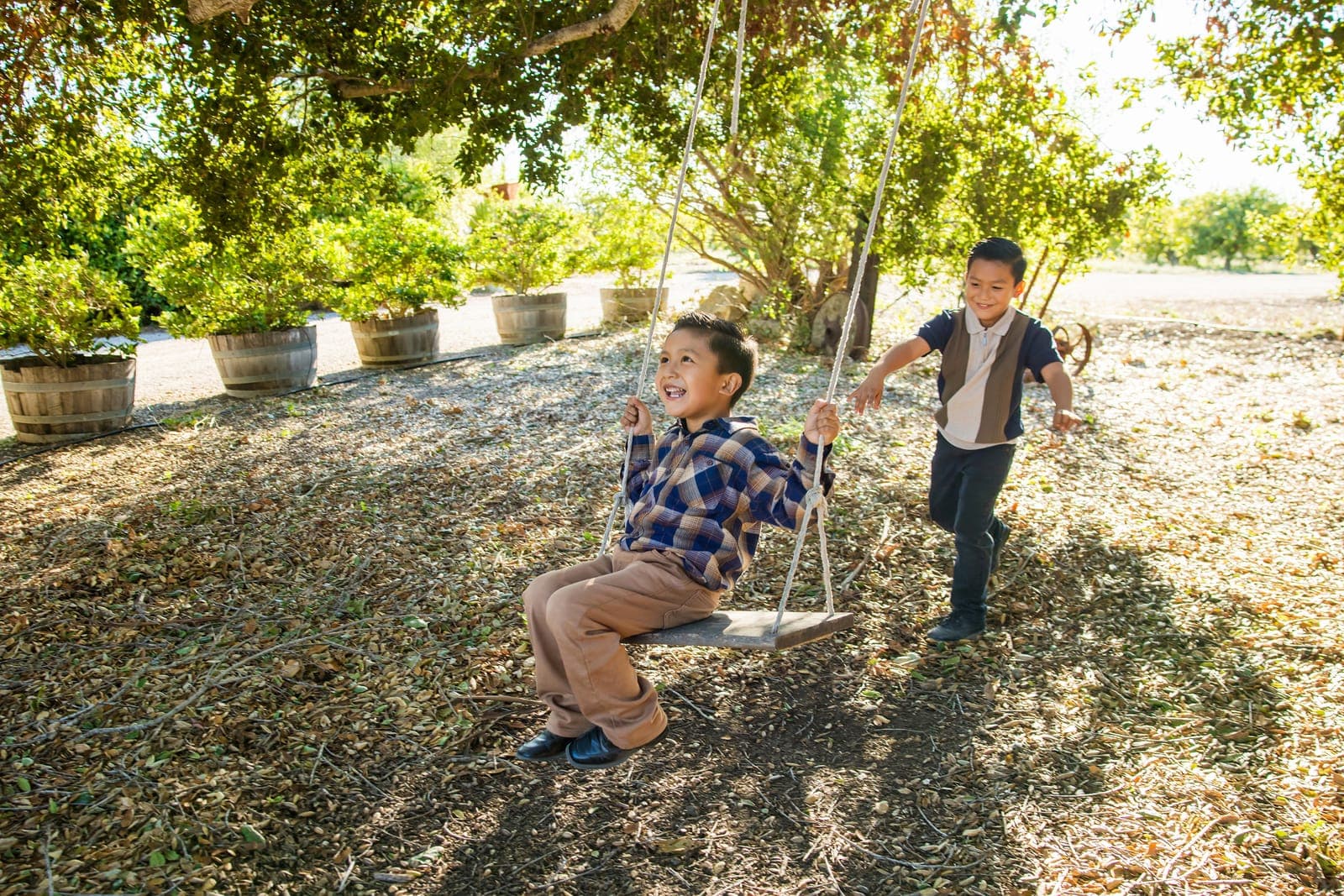
Two to four. The shortest fuse and the best photographs, usually in that order. We photograph everything that needs this child in the first stretch of the session. I do not ask them to sit still; I ask them to run toward their dad, jump off a log, or whisper something to their sister, because a two-year-old holding a pose looks like a two-year-old holding a pose. The swing photograph at the top of this page is what that approach produces.
Five to eight.This age wants to help, which is lovely, and wants to perform, which is the problem. This is peak cheese-face territory. The fix is to give them something real to do — a job, a question to answer, a joke to react to — so the expression is a response to something rather than a pose they have decided on.
Nine to twelve. Self-consciousness arrives, often suddenly, and frequently about braces, height, or a haircut. Do not tease about any of it on the day, even affectionately. Let them have an opinion about their own outfit within the palette you have agreed, and give them a solo portrait or two — being taken seriously is what turns this age around.
Teenagers. Talk to them directly rather than through you, and the resistance usually evaporates within ten minutes. Most teenagers are not opposed to the photographs; they are opposed to being managed in front of their family. If you have a high school senior in the house, their own session is a different thing entirely, and worth having separately.
The Day Itself
Work backwards from the start time. Every outfit, including shoes, socks, hair ties, and your own clothes, comes out of the closet the night before — the morning-of search for one missing sandal is what makes families arrive stressed. If you are still deciding what everyone is wearing, my guide to what to wear for family photos covers palettes, coordinating without matching, and dressing children for the camera.
Dress small children last, and in the car if you can manage it. Breakfast, the drive, and a toddler in a clean white shirt are three things that should not overlap. Aim to arrive ten minutes early rather than exactly on time, so the first thing your child does at the location is look around rather than be rushed out of a car door.
If we are outdoors in the middle of a summer day rather than at golden hour, pack sun protection properly. The American Academy of Pediatrics advises limiting sun exposure between 10:00 a.m. and 4:00 p.m. when UV rays are strongest, recommends a hat with an all-around three-inch brim, and says to keep babies younger than six months out of direct sunlight. Hats come off for the photographs and go straight back on between setups. One underrated advantage of the late-afternoon slot on Pismo Beach or Avila Beach is that it sits almost entirely outside that window.
Then hand the session over. Your job for the next hour is to be a parent in the photographs — to look at your children, hold them, laugh at them — and not to be a second photographer standing behind me.
What to Pack
One bag, and it stays in the car or off to the side. Everything on this list earns its place.
- Water for everyone, and a snack that is not red, sticky, or crumbly
- Baby wipes, for hands, faces, and whatever the snack did anyway
- A full backup outfit for anybody under about six
- A hairbrush, a few spare hair ties, and a small mirror
- One small familiar toy — not a new one, and not anything that lights up
- Hats and sunscreen for daytime sessions, and a towel for the beach
- Something to carry sandy shoes home in
The toy matters more than it sounds. A familiar, slightly battered one is a comfort object; a brand-new one is a competing attraction, and anything that lights up or makes noise will be in every frame for the rest of the hour. If a dog is coming too, my guide to family photos with dogs has its own packing list and explains why you want an extra adult along.
When It Goes Sideways
It will, at some point, in roughly a third of sessions with small children, and it is not a crisis. Here is what actually happens when a four-year-old decides they are finished.
We stop. Young children in my sessions are welcome to take breaks, have snacks, and play between setups, and three minutes of running around resets most of them completely. While that is happening I keep working: the parents together, the older siblings, the grandparents, a portrait of the child who is still cheerful. A family session has a dozen groupings in it and only some of them need everybody, which is one of the practical reasons I prefer a full session over a shorter format — my comparison of a mini session versus a full session goes into why time is the tool that makes photographs of young children work.
What does not help is a parent leaving the frame to negotiate. A thirty-second mood becomes a ten-minute standoff the moment it acquires an audience and a bargaining partner.
Three Things Parents Do That Backfire
- 1Standing behind me and calling your child's name. They look at you, which means they look away from the camera, and now two adults are competing for the same two-second window. If I need their eyes, I will get their eyes.
- 2Negotiating inside the frame. “If you do not smile, we are not getting ice cream” produces a specific facial expression, and it is not the one you want above the fireplace. Let the reward stay in the future where it belongs.
- 3Apologizing for your child. A four-year-old who hears their parent say sorry about them three times in twenty minutes gets quieter, not easier. Nothing your child does at a portrait session is new to me, and none of it needs an apology.
None of this is a judgment. Every one of these comes from a parent wanting the session to go well, which is the right instinct pointed in the wrong direction. The photographs you are going to keep are the ones where your family forgot about me, and that is much easier to arrange when the adults have stopped working.
If you want to see how the whole process fits together before you book — the consultation, the session, and the reveal afterward — the experience page walks through it, and the family photography page covers what a session includes.
Sources
- American Academy of Sleep Medicine — Child Sleep Duration Health Advisory (consensus recommendations endorsed by the American Academy of Pediatrics: “11 to 14 hours per 24 hours (including naps)” for ages 1–2, “10 to 13 hours per 24 hours (including naps)” for ages 3–5, and “9 to 12 hours per 24 hours” for ages 6–12; meeting them is associated with “improved attention, behavior, learning, memory, emotional regulation, quality of life, and mental and physical health”)
- Centers for Disease Control and Prevention — Milestones by 9 Months (social/emotional milestones include “Is shy, clingy, or fearful around strangers”)
- American Academy of Pediatrics (HealthyChildren.org) — Sun Safety (“Limit your sun exposure between 10:00 a.m. and 4:00 p.m., when UV rays are strongest”; “Wear a hat with an all-around 3-inch brim to shield the face, ears, and back of the neck”; “keep babies younger than 6 months out of direct sunlight”)
- Eric Jaffe, “The Psychological Study of Smiling” — Association for Psychological Science Observer (“only the peculiar tango of the zygomatic major and the orbicularis oculi produces a genuine expression of positive emotion”; Duchenne found that “the zygomatic major can be willed into action, but that only the ‘sweet emotions of the soul’ force the orbicularis oculi to contract”)
- Ekman, P., Davidson, R. J., & Friesen, W. V. (1990). “The Duchenne smile: Emotional expression and brain physiology II.” Journal of Personality and Social Psychology, 58(2), 342–353 (smiles in which the muscle orbiting the eye was active tracked enjoyment across film viewing, cerebral asymmetry measures, and self-reported positive emotion; other smiling did not)