
Family Photography
Family Photos With Dogs
Yes, bring the dog. Family photos with dogs work when you plan four things in advance: photograph the dog in the first fifteen minutes while everyone is fresh, bring one adult who is not in those frames to handle the leash, leave the leash on and let it hang slack, and pick a location that allows dogs at the hour you are booking. Everything after that — the sitting, the standing, the ears-up look toward the camera — is my job, not yours.
The Short Version
Everything below is expanded on in the rest of this guide, but if your session is next week, this is the whole plan.
- 1Decide honestly whether your dog belongs in the whole session or just the first fifteen minutes of it.
- 2Ask one adult who will not be in the dog photographs to come along as the handler.
- 3Photograph the dog groupings first, while the light is good, the clothes are clean, and everyone is fresh.
- 4Leave the leash on, keep it slack, and let it hang straight down where it is easy to remove later.
- 5Choose a location that allows dogs at the hour you are booking — the rules change by beach and by time of day.
- 6Dress the family around your dog's coat color, and swap the walking harness for a simple collar or a bandana.
- 7Pack water, small treats, a towel, and a lint roller, and plan for the cooler end of the day.
Should Your Dog Be in the Photographs at All?
Almost always, yes. Your dog lives in the house, sits under the table at dinner, and sleeps on somebody's bed. A family portrait that leaves them out is a portrait of most of your family, and ten years from now that is the thing you will notice about it.
The honest test is not whether your dog is well trained. It is whether they can be somewhere new, with the people they love, for a short stretch of time, without being miserable. A dog who pulls on the leash, cannot hold a sit, and has no idea what is happening can still be photographed beautifully. A dog who is frightened of strangers, reactive toward other dogs on a public beach, or genuinely unwell is a different conversation, and I would rather have it at the consultation than on the day.
There is a middle answer that almost nobody thinks of, and it is usually the right one: the dog comes for part of the session. We photograph the family with the dog in the first fifteen minutes, the handler walks them back to the car or home, and the remaining groupings carry on without them. You get the portrait with your dog in it and nobody spends an hour managing an animal who has run out of patience. If you want more than a few frames of your dog specifically, that is what a dedicated pet photography session is for.
Bring a Dog Handler. This Is the Whole Trick.
Here is the problem nobody anticipates. At a pet session, the owner stands behind me with a squeaky toy and the dog looks wherever I need them to look. At a family session, every adult in your household is standing in the frame. There is nobody left to hold the leash, catch the dog when they decide to investigate a seagull, or stand three feet behind my shoulder making a noise the dog has never heard.
So bring someone. A grandparent who is not in that particular grouping, a neighbor, an adult sibling, a teenager who is happy to sit out the first few frames. Their job is small and enormously valuable: walk the dog before we start, hold the leash just outside the edge of the frame, hand me the treats, carry the water, and take the dog away the moment we are done with them.
One more thing the handler does: they do the calling. When four people say a dog's name at the same time, the dog looks at the people — which is the one direction I do not want them looking.
Photograph the Dog First
A family session runs one to two hours, because we work through the whole family, the parents together, the siblings, the individual portraits, and the extended family if they are joining. Your dog does not have one to two hours of cooperation in them. On a beach or in an open field, most dogs have their best fifteen minutes right at the start and spend the rest of the hour increasingly convinced that something more interesting is happening elsewhere.
So we front-load them. The whole family with the dog, the kids with the dog, and anything else you want them in, all inside the first stretch while the attention is there. It has a second benefit that parents appreciate: clothes are cleanest, hair is tidiest, and nobody has sand on them yet. Then the handler takes the dog off for a walk, and the session moves on at human pace.
Leashes Stay On
Clients ask this at almost every session, so here is the plain answer: leave the leash on. On most Central Coast beaches and trails it is legally required anyway, and a dog who is safely attached to a person is a dog who is relaxed, which shows in the photograph far more than a leash does.
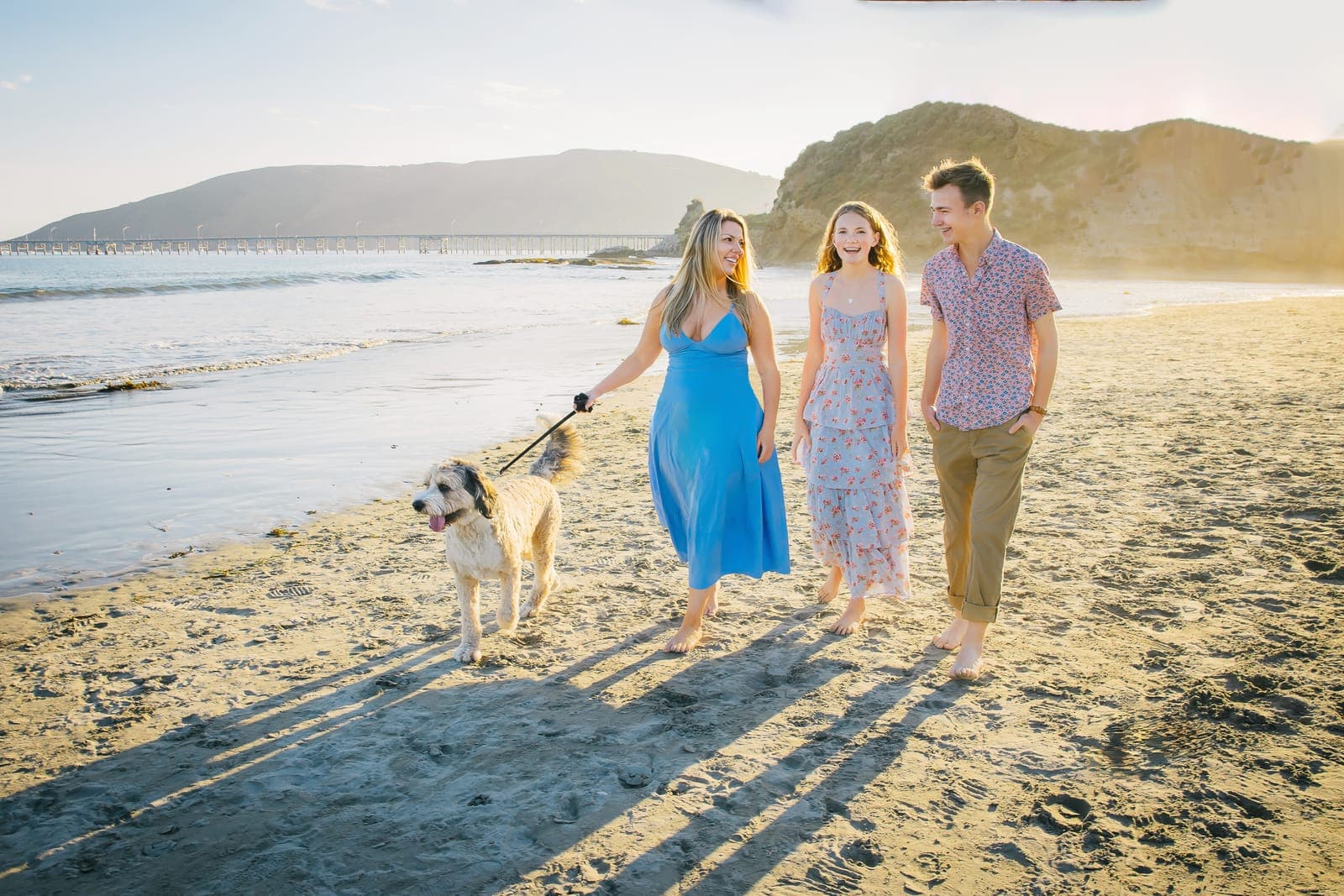
What matters is how the leash behaves. A thin leash hanging slack and straight down from a hand held low is one of the easiest things to retouch out of a finished portrait. A thick, neon-colored leash pulled tight across a child's legs or diagonally over the dog's chest is not — removing it means rebuilding whatever it was covering. Before your session, dig out the thinnest leash you own in the color closest to what your family is wearing, and let it stay loose in the frame. The photograph at the top of this page has a leash in it, running from a hand to a collar in plain view.
Where Dogs Can Actually Go on the Central Coast
This is the part families get wrong, because the rules are not the same from one stretch of sand to the next, and at one of our best locations they change by the hour.
Pismo State Beach. California State Parks states that dogs are allowed on the beach and park trails but must be kept on a leash no longer than six feet at all times, and that dogs are not allowed at the Pismo Dune Preserve or at Oso Flaco Lake. The sand beneath and around the pier, where a lot of my favorite family frames are made, is dog-friendly on that six-foot leash.
The City of Pismo Beach. Outside the parks the city council has specifically designated, the municipal rule is that any person owning or possessing a dog must keep the animal on a leash not exceeding six feet in length. That covers the bluff-top parks along Price Street, which are some of the prettiest late-afternoon backgrounds on this coast.
Avila Beach — check the clock. The Port San Luis Harbor District allows dogs off-leash and under voice-command control on Avila Beach before 10:00 a.m. and after 5:00 p.m. daily, and states that between 10:00 a.m. and 5:00 p.m. there are no dogs allowed on Avila Beach except service dogs. Nearby Olde Port Beach is leash-optional throughout the day, and no dogs at all are allowed on Fisherman's Beach.
That 5:00 p.m. line matters more than it sounds. From spring through fall it is no obstacle at all, because the golden hour we want for an Avila Beach family session falls comfortably after it. In December it is the opposite: the sun sets around 4:52 p.m., so the best light of the day happens entirely inside the window when dogs are not permitted on that beach. A winter session with your dog belongs somewhere else, or in the studio.
For the individual spots and what each one needs, my guides to the best photo locations in Pismo Beach and the best photo locations in San Luis Obispo both note which ones welcome dogs and which require a permit.
What Everyone Wears When There Is a Dog in the Frame
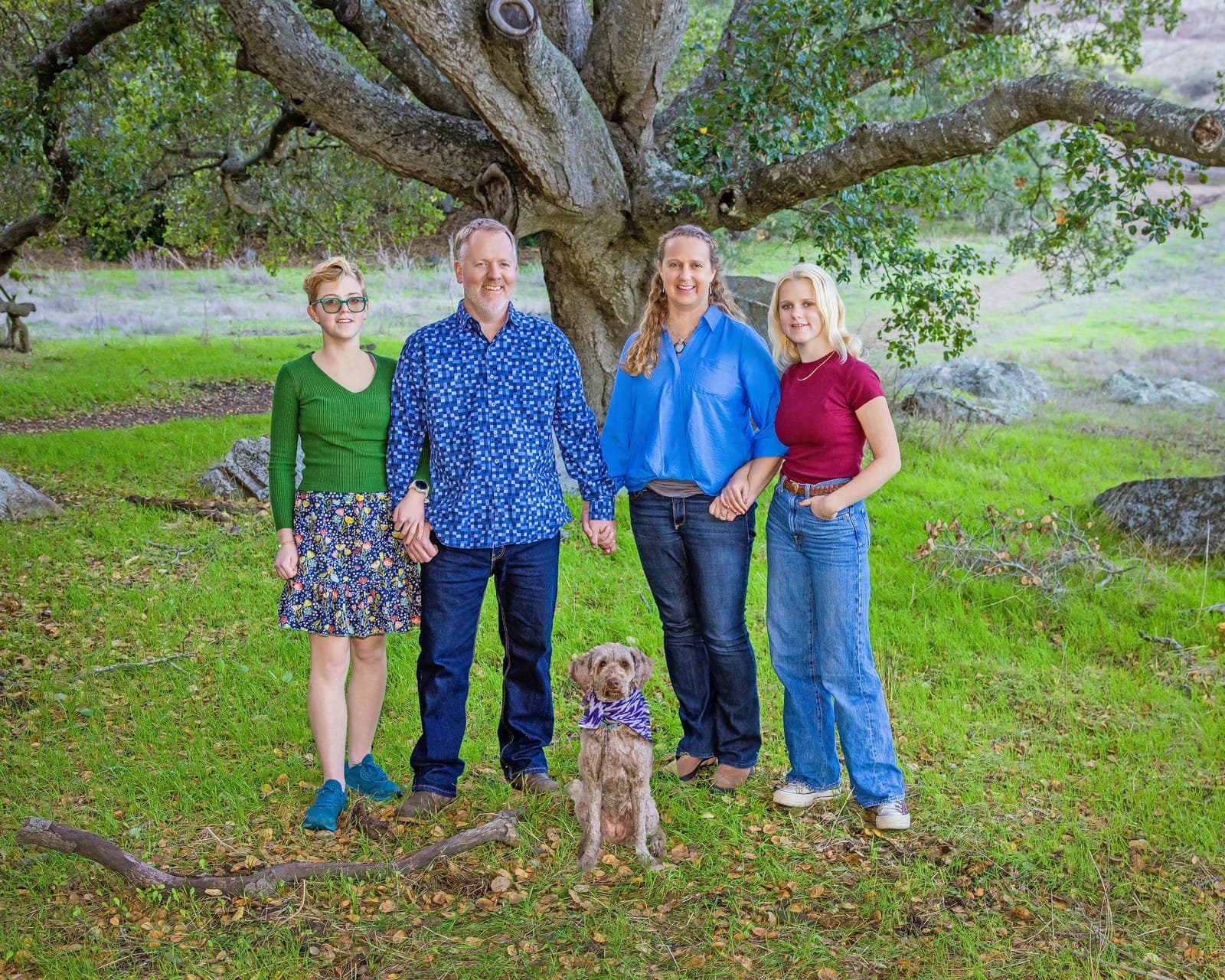
Your dog is wearing a coat you cannot change, so build the family's colors around it rather than against it. A black Labrador standing in front of four people in black and charcoal becomes a dog-shaped hole in the photograph; give them a lighter background to stand against and they read as a dog again. A cream-colored dog on pale sand has the same problem in reverse. Send me a photo of your dog when we plan wardrobe, and I will work it into the palette the same way I work in everybody else's clothing.
Then there is the hair. Dark trousers and a shedding dog is a combination you will see in every frame, so keep a lint roller in the car and use it after you have finished hugging the dog, not before. Beach sessions add wet sand to the equation: if your dog is going anywhere near the water, put the person in the palest clothing at the far end of the group.
As for the dog's own wardrobe — less is better. A clean collar, or a bandana in one of the colors your family is already wearing. Take the walking harness off before we start; it covers the chest and shoulders, which is most of what makes your dog look like your dog. Costumes and holiday sweaters are fun for a frame or two at the end, but they are not what you want above the fireplace in five years. The rest of the wardrobe thinking is in my guide to what to wear for family photos.
Heat, Timing, and Reading Your Dog
The late-afternoon hour that flatters people also happens to be the kindest one for a dog. The American Kennel Club notes that short-snouted dogs are more sensitive to high heat and humidity, and that dogs with thick or double coats, dark-colored coats, overweight dogs, and elderly dogs are all at higher risk. If your dog is any of those, the session time is not a style preference, it is a welfare decision — and it is another reason my guide to the best time of year for outdoor photos keeps landing on the hour before sunset.
The AKC lists frantic or excessive panting, extreme salivation or thick saliva, bright-red gums or tongue, and labored breathing among the signs of overheating. Any of those and we are finished outdoors for the day, whatever is still on my shot list. Dry sand in the afternoon holds a surprising amount of heat too, which is one more argument for the later slot.
Stress is quieter than heat, and it shows up long before a dog does anything dramatic. In its guide to dog body language, the American Kennel Club describes these as signs a dog is feeling stressed, anxious, or fearful:
- Yawning when they are not remotely tired
- Lip licking with no food anywhere nearby
- Whale eye — the whites of the eyes showing
- A tail carried low or tucked between the legs
- Hunching low to the ground, or trying to move away
- Pointedly looking away and avoiding eye contact
When I see them, the dog goes for a walk with the handler and we photograph a grouping that does not need them. Nine times out of ten they come back settled and we get the frame. The tenth time we have already taken the picture, because we photographed the dog first.
What to Bring
- The treat your dog would cross a parking lot for, cut into small pieces
- Water and a collapsible bowl, even for a short session
- A leash no longer than six feet — thin, and as close to your clothing colors as you own
- A simple collar or a bandana that fits the family palette, with the walking harness left in the car
- A brush, and a lint roller for everyone else
- Waste bags, and a towel for sandy paws and wet feet
- One adult who is not in the photographs to handle the dog
I bring treats and toys of my own as well, but the one your dog already loves beats anything new I can produce. A word on the walk beforehand: a normal one takes the edge off. An exhausting hike gives you a dog who is too tired to lift their head and too hot to close their mouth.
The Studio Is a Real Option
Not every dog belongs on a public beach, and not every family wants one in the picture. My Grover Beach studio has no leash laws, no seagulls, no other dogs, no wind, and no marine layer, which makes it the honest answer for a dog who is anxious in public, a December session, or a family who simply wants the clean, timeless look. Dogs are photographed on the same furniture everybody else sits on, and studio lighting sounds alarming for an animal but is shaped, bounced, and introduced gradually. You can see how the setting works on my in-studio family photography page.
Where to Go Next
Everything a session includes is on my family photography page, with local detail for family photography in Pismo Beach and San Luis Obispo. If your dog is the reason you are booking at all, my guide to what to expect at a pet photo session covers the dedicated version, and how to photograph your dog covers the pictures you take yourself in between. The full process from consultation to finished artwork is on the experience page.
Sources
- Port San Luis Harbor District — Beach Regulations (“Dogs are allowed off-leash and under voice-command control on Avila Beach before 10:00 a.m. and after 5:00 p.m. daily. Between 10:00 am and 5:00 pm there are NO dogs allowed on Avila Beach except for Service dogs”; dogs allowed off-leash on Olde Port Beach; “No dogs are allowed on Fisherman's Beach”)
- California State Parks — Pismo State Beach (“Dogs are allowed on the beach and park trails but must be kept on a leash, not longer than six (6) feet, at all times”; “Dogs are not allowed at the Pismo Dune Preserve or at Oso Flaco Lake”)
- City of Pismo Beach — City Rules for Pets (“Any person owning and/or possessing a dog must keep the animal on a leash not exceeding six feet in length”, except on private property, when assisting law enforcement, or in parks designated by a resolution of the city council)
- American Kennel Club — Overheating in Dogs: Signs, Symptoms, Prevention (short-snouted dogs “may be more sensitive to high heat and humidity”, with thick- or double-coated, dark-coated, overweight and elderly dogs at higher risk; signs include “frantic or excessive panting, extreme salivation or thick saliva, bright-red gums or tongue, labored breathing”)
- American Kennel Club — How to Read Dog Body Language (Stephanie Gibeault, MSc, CPDT: “dogs yawn when they're stressed”; lip licking happens “when they feel anxious”; showing the whites of the eyes “is a signal that they're feeling anxious or stressed”; tails pointing down or tucked indicate “fear and stress”; cowering and looking away as signs of stress)
- U.S. Naval Observatory — Sun and Moon Data for One Day (sunset at Pismo Beach in December is about 4:52 p.m.; the same figures underpin the timing in my best-time-of-year guide)