
Senior Portraits
Senior Pictures With Your Dog
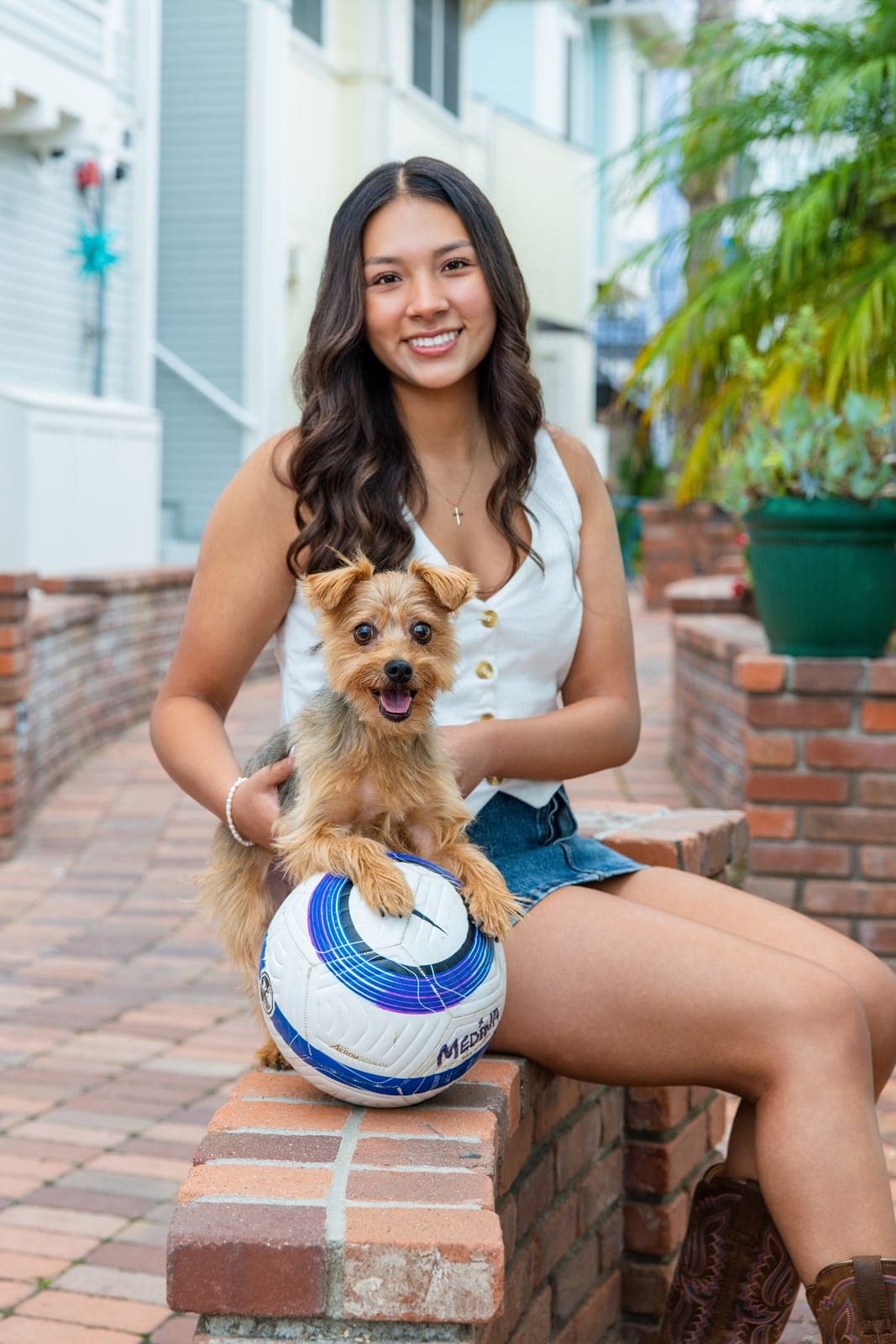
For a lot of seniors, the dog is not a prop that got added to the list. The dog arrived when you were seven, slept at the end of your bed through middle school, and is the reason you have come home at a reasonable hour for the last four years. Putting them in your senior pictures is not a cute idea — it is an accurate one. Here is how to plan the session so it actually works, and so you end up with the picture you were imagining rather than twenty frames of a leash.
The Short Version
Everything below is explained properly further down, but if your session is this week, this is the whole thing in eight lines.
- 1Decide up front whether the dog is in a few frames or the whole session. For almost everyone, it is a few.
- 2Keep your yearbook portrait dog-free — schools crop it to head and shoulders of you alone.
- 3Bring one adult whose only job is the dog. It cannot be you, and it should not be the person carrying your outfits.
- 4Pick one outfit for the dog block and shoot it early, while the clothes are still clean.
- 5Check the location rules before you fall in love with a spot. Cal Poly allows leashed dogs outdoors; most state beaches allow none at all.
- 6Pack a plain six-foot leash and a simple collar. No retractable leash, no walking harness.
- 7Bathe and groom two or three days ahead, not the morning of.
- 8Plan for a useful window of twenty to thirty minutes, and build the rest of the session around it.
Decide Which Pictures the Dog Is Actually For
This is the first conversation, and it saves the session. Your senior portraits are doing two separate jobs. One is the yearbook submission, which your school crops tightly to head and shoulders of you by yourself — anything below your collarbone is gone before it reaches the page, and that includes a dog in your lap. The other job is everything else: the frames that get printed large, the ones your mom puts in the hallway, the one that still hangs there in fifteen years.
The dog belongs entirely to the second job. Once you accept that, the planning gets simple: we shoot a clean yearbook look as its own setup with its own uncomplicated top, and we shoot the dog frames as their own thing, and neither one has to compromise for the other. The school requirements are specific enough that it is worth reading them before you pack — I go through them, along with the rest of the day’s logistics, in what to bring to a senior photo shoot.
Be honest about quantity, too. Almost nobody wants a whole senior session with their dog in it; what people want is four or five really good frames with the dog, inside a session that is otherwise about them. Planning for four or five is how you get four or five. Planning for forty is how you get a tired dog and a senior who never reached the outfit they were most excited about.
Somebody Has to Hold the Leash, and It Cannot Be You
This is the single most common reason dog frames do not work, and it is a staffing problem rather than a dog problem. At a family session there are four other people standing in the picture, and any one of them can take the leash. At a senior session there is you, and there is me, and that is usually it.
A leash in your hand does real damage to a portrait. It drops the shoulder it is attached to, straightens the arm, locks your weight onto one hip, and — the part nobody expects — it puts you half a second behind every frame, because you are managing an animal instead of being photographed. So bring a handler. The handler’s entire job for twenty minutes is to stand just outside the edge of the frame, keep the leash slack and low, make the noise when I ask for it, and take the dog back the instant we are done.
Two specifics worth planning. First, it should not be the same person carrying your outfit bag and your water — those two jobs collide at exactly the wrong moment. Second, if your dog recalls reliably to one particular person in your house, bring that person rather than whoever happens to be free that afternoon. A dog who is watching the right human over my shoulder gives you a better expression than a dog who is wondering where their person went. The same logic, with more hands available, is why family photos with dogs run the way they do.
Where You Can Actually Bring a Dog
Seniors ask for campus, and campus is genuinely one of the better answers. Cal Poly’s Animals on Campus policy allows pets on the grounds when they are “secured by a leash up to six (6) feet maximum in length, the other end of which is retained by a person,” and states plainly that “pets are not permitted in any campus building except for service animals.” The same policy requires that “dogs must have a valid license as well as evidence of a current rabies vaccination,” and that pets “may not be left unattended on campus.” In practical terms: the lawns, the steps, the architecture and the oaks all work, the inside of any building does not, and your dog needs their paperwork in order. San Luis Obispo County requires dogs over four months old to be licensed, and a current rabies vaccination is a condition of that license.
Your own high school is a different question, and I will not pretend otherwise: campuses are district property, policies vary, and the answer usually depends on asking the front office rather than on anything published. If a shot in front of your school matters to you, ask early, because that one is worth knowing before we build the route.
The coast is the one people assume is easiest and it is actually the most restricted. California State Parks requires that “dogs must be on a maximum 6-foot leash at ALL times and physically under your control,” adds that dogs “must not be left unattended,” and notes that most state beaches are closed to dogs altogether, with access varying park by park. I keep the Central Coast specifics — which beaches, which hours, which jurisdiction — in family photos with dogs, and we confirm the exact stretch at your consultation rather than discovering it at golden hour.
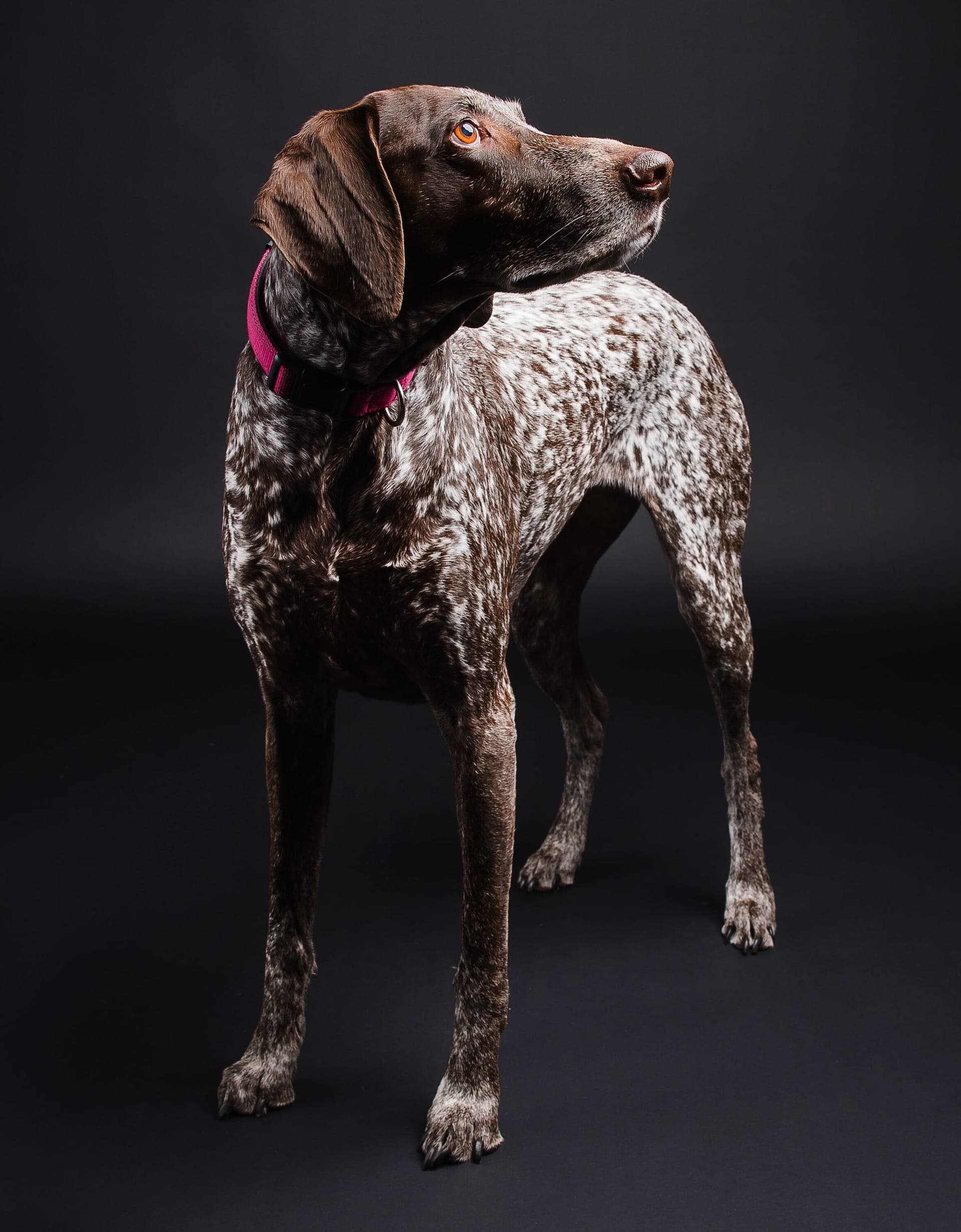
Then there is the studio in Grover Beach, which is the option people underrate. No wind, no other dogs, no squirrel, no tide, and light that does not change while we work. For a nervous dog, an old dog, or a black dog whose coat needs real lighting rather than whatever the sky is doing, the studio is not the fallback — it is the better room. We can do a studio block and an outdoor block in the same session if your senior session is built that way.
Pick the One Outfit the Dog Belongs In
You are bringing three to five looks. The dog belongs in exactly one of them, and choosing which one before the session is the difference between a relaxed twenty minutes and a scramble.
Pick the most forgiving outfit you own, and shoot it early. A dog will put their paws on you, shed on you, and lean their whole body weight against your leg, which is exactly what you want them to do and exactly what a black crepe dress does not survive. Denim, a neutral knit, a jacket you already live in: those photograph beautifully and they do not record every hair. If your heart is set on the formal look, we do that one after the dog has gone home with their handler.
Then look at your dog’s coat as part of the color palette, because the camera will whether you do or not. A cream dog against a cream sweater disappears into you. A black dog against black clothing becomes one shape with two heads. Put some separation between the two — your dog’s coat and your top working as contrast rather than camouflage — and the frame reads instantly. There is more on building a lineup that holds together in senior picture outfit ideas.
Twenty to Thirty Minutes, and Where They Go
A senior session here runs an hour and a half to two and a half hours. Your dog does not. Most dogs give you a genuinely good twenty to thirty minutes at a new location before the novelty wears off and they start wanting something else to happen, and trying to stretch that into an hour produces pictures of a dog who would rather be in the car.
So we spend that window deliberately, near the front of the session while your hair is still exactly as it was when you left the house and your clothes have not met any sand. The handler takes the dog home or to the car afterward, and the rest of the session runs normally. If your dog is older or anxious, we go shorter still and stop on a good frame rather than on a tired one.
Grooming has its own timing. Bathe and groom two or three days ahead rather than the morning of — a coat looks its best once it has settled, and a dog who has just been through a groomer is often wound up rather than photogenic. And if your session is a warm one, remember that your dog is wearing a coat all day and you are not. Water, shade and a real break between setups are not optional extras.
What to Pack for the Dog
Short list, packed in its own bag so it does not end up at the bottom of the one holding your outfits.
- A plain six-foot leash in a neutral color. Black and tan photograph best, and a flat nylon or leather lead retouches out of a frame far more cleanly than a retractable handle.
- A simple collar, or a bandana that sits inside your color palette. Leave the walking harness in the car — it covers the chest and shoulders, which is most of the dog.
- High-value treats broken into small pieces, and one squeaker or crinkle held in reserve for the frames that need ears up.
- Water and a collapsible bowl, every time, even in December.
- A towel for sand, wet paws and drool, and a second one for the car.
- Waste bags, more than you think.
- A lint roller for you, in the bag with your outfits rather than at home on the counter.
- Your dog's license tag and proof of current rabies vaccination if we are photographing on the Cal Poly campus.
- Their own blanket or bed if we are in the studio. A familiar smell settles a dog faster than anything I can do.
About the Leash in the Picture
People ask whether the leash has to come off, and the honest answer is that it almost never does. Where a leash is required we keep the leash on; a thin lead held low by a handler just outside the frame is unobtrusive to begin with and can usually be retouched out of a finished image afterward. That is a far better trade than breaking a posted rule, or spending the best light of the day calling a dog back. It is also why the leash you bring matters: a flat lead in a neutral color disappears, while a retractable leash with a hard plastic handle is bulky in frame, awkward to hold slack, and genuinely difficult to remove cleanly in editing.
If This Is the Dog You Grew Up With
Here is the part I think about most, and the reason I never treat the dog block as an add-on. Do the arithmetic on your own dog. If they came home when you were in second grade, they are somewhere around ten years old right now. The American Kennel Club notes that small breeds are “often considered seniors sometime between 8 and 12 years old,” that giant breeds “may reach this stage as early as 6 or 7 years old,” and that many veterinarians treat a dog as senior once they have reached “roughly the final quarter of their expected lifespan.”
Which means your senior year and your dog’s senior years are very often the same year. You are about to leave for school, and the dog who has been in every version of your childhood is already sleeping more than they used to. The pictures we take in that twenty-minute block are not really about senior year at all. They are the last good portraits of a dog, made at the one moment everyone in the family happened to be paying attention.
That is also why, while they are here and in a good mood, I will take a few frames of your dog alone. It costs ten minutes and families are glad of it later — I wrote about why, including the times I would tell you not to bother, in are pet photos worth it. If what you really want is a proper portrait session for the dog rather than a few frames inside yours, that is its own session, and the dog gets the whole studio to themselves.
Before You Book
Tell me the dog is coming at the consultation rather than on the day — it changes which locations I suggest, how I order the session, and what I bring. And tell me if your dog is nervous with strangers or reactive to other dogs. That is a planning detail rather than a confession, and the pictures are better for it.
If you are still working out the calendar, my guide to when to book senior photos works backward from local yearbook deadlines, and the experience page walks through how a session runs from the first conversation to the reveal. Between sessions, if you want better photos of your dog on your own phone, I put everything I know into how to photograph your dog.
Sources
- Cal Poly Campus Administrative Policy 353 — Animals on Campus (pets permitted when “secured by a leash up to six (6) feet maximum in length, the other end of which is retained by a person”; “pets are not permitted in any campus building except for service animals”; “dogs must have a valid license as well as evidence of a current rabies vaccination”; “pets may not be left unattended on campus”)
- California State Parks — Visiting State Parks With Your Dog (“Dogs must be on a maximum 6-foot leash at ALL times and physically under your control”; “Dogs must not be left unattended”; most beaches are closed to dogs and access varies park by park)
- San Luis Obispo County Animal Services — Dog Licensing (licensing required for dogs over four months of age; proof of current rabies vaccination required with the application, and a license cannot extend beyond the expiration of the rabies vaccine)
- American Kennel Club — Is Your Dog a Senior? (Gemma Johnstone) (small breeds are “often considered seniors sometime between 8 and 12 years old”; giant breeds “may reach this stage as early as 6 or 7 years old”; many veterinarians and researchers treat a dog as senior once they have reached “roughly the final quarter of their expected lifespan”)