
Family Photography
Beach Family Photo Tips
A beach session is not just an outdoor session that happens to be on sand. Five things behave differently here — the wind, the tide, the direction of the light, what the ground does to your clothes, and the water your children can see the whole time. Plan for those five and a beach session is the easiest beautiful photograph you will ever be in. Ignore them and you get squinting, hair across faces, and a narrow strip of trampled sand at high water.
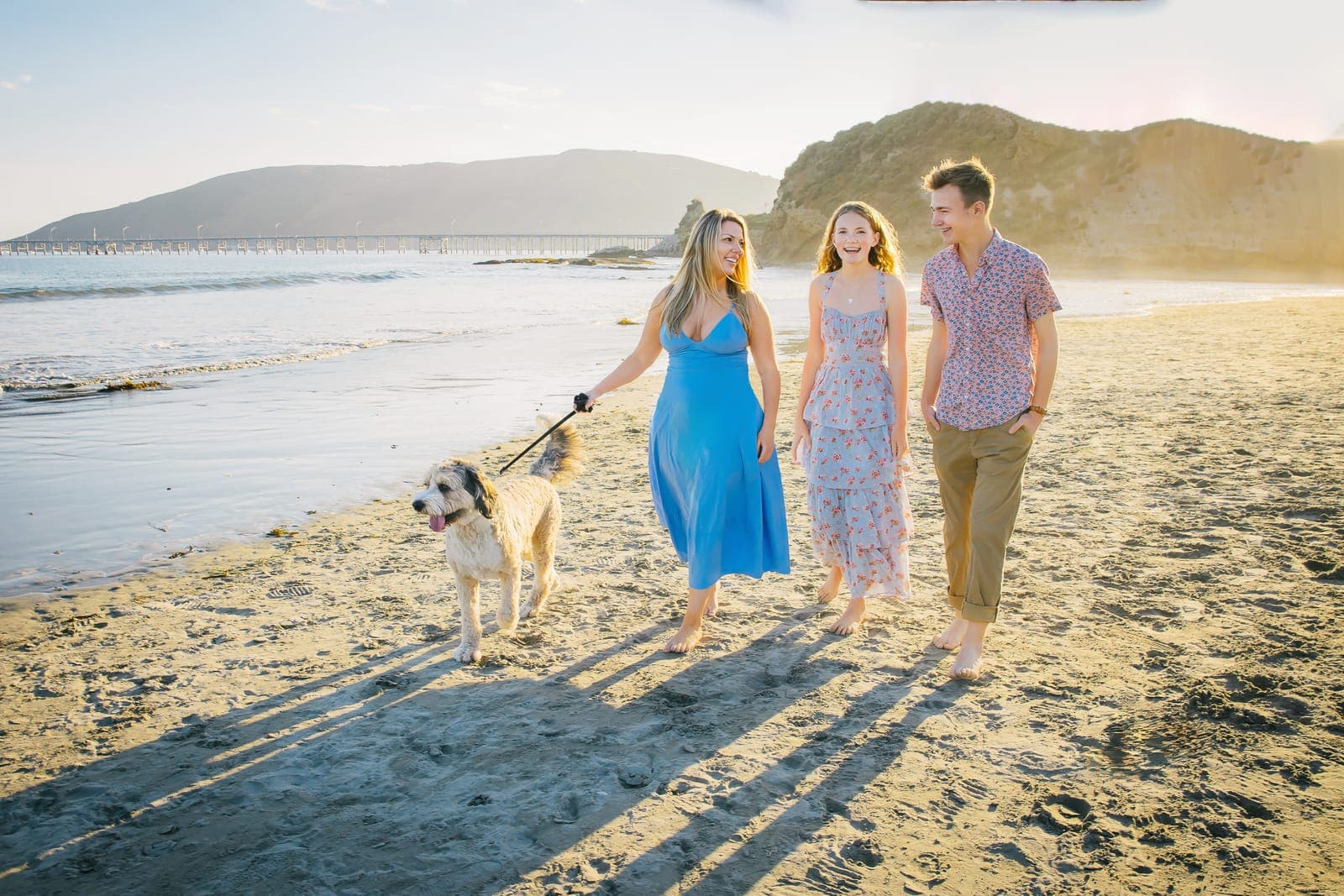
The Short Version
The rest of this guide explains why. If your beach session is already booked, this is the whole plan.
- 1Book the last hour before sunset — it is usually both the best light and the calmest wind of the day.
- 2Check the tide chart against the sunset time before you lock the date, not after.
- 3Expect to be photographed into the sun, and trust it; the alternative is everyone squinting.
- 4Dress for movement in light fabrics, and keep long hems clear of the wet sand.
- 5Go barefoot, and bring a bag for the sandy shoes.
- 6Decide in advance whether the kids are going in the water, and tell me which it is.
- 7Reapply sunscreen even on a gray day — sand and sea foam throw UV straight back up at you.
The Wind Drops Before the Sun Does
Wind is the variable families never plan for and always remember. It is also the one with the most reliable daily pattern, which makes it the easiest to beat.
A sea breeze is driven by the land heating faster than the ocean. It builds as the day warms, and as the University of British Columbia's atmospheric science course puts it, “the sea breeze is strongest mid-day through mid-afternoon local time,” with typical near-surface speeds at the coast of about 22 km/h — roughly 14 miles per hour — and a range running from near-calm up to about 25 miles per hour. Then comes the part that matters for your photographs: the same source notes that the sea breeze “can die in the late evening BEFORE the sun sets.”
Read that together and the booking decision makes itself. The last hour before sunset is not only when the light comes in low and warm across the water instead of straight down — it is frequently the calmest hour of the day on the sand. You get the best light and the least wind in the same window. A midday beach session, by contrast, collects hard overhead light and the windiest part of the afternoon simultaneously.
None of which means wind is the enemy. A light breeze is why beach portraits look like beach portraits: hair with movement in it, a dress that has shape rather than hanging flat. What I plan against is the twenty-mile-an-hour afternoon that puts hair across every face and makes a four-year-old miserable. If you want the broader seasonal picture, my guide to the best time of year for outdoor photos has the month-by-month wind, rain, and marine layer data for this coast.
Check the Tide, Not Just the Sunset
This is the single most overlooked thing about photographing on a beach, and it is free to get right.
At Port San Luis — NOAA station 9412110, the tide reference for this stretch of coast — the mean range of tide is 3.58 feet, and the spread from mean higher-high water to mean lower-low water is 5.33 feet, measured over the 1983–2001 tidal datum epoch. Five feet of vertical water movement does not sound dramatic until you remember that a beach is a ramp. On gently sloping sand, that vertical change moves the waterline a long way in and out, and it decides how much beach exists on the afternoon you booked.
A low or falling tide gives you three things at once: room to spread a family out and move them around, firm damp sand that is far easier to walk on than loose dry sand, and the wet mirror at the water's edge that doubles a family back at the camera. That reflection is the most reliably beautiful surface on this entire coast, and it only exists when the water has recently been there. A high tide can leave a narrow, crowded strip of soft sand churned up with the day's footprints.
So I check the tide chart against the sunset time before I confirm a beach date, and if the two do not line up that week we move one or the other. Tides matter in a second, sharper way at the water-level spots — the tide pools and the small coves simply do not exist at high water — and my guide to the best photo locations in Pismo Beach goes through which specific spots depend on it.
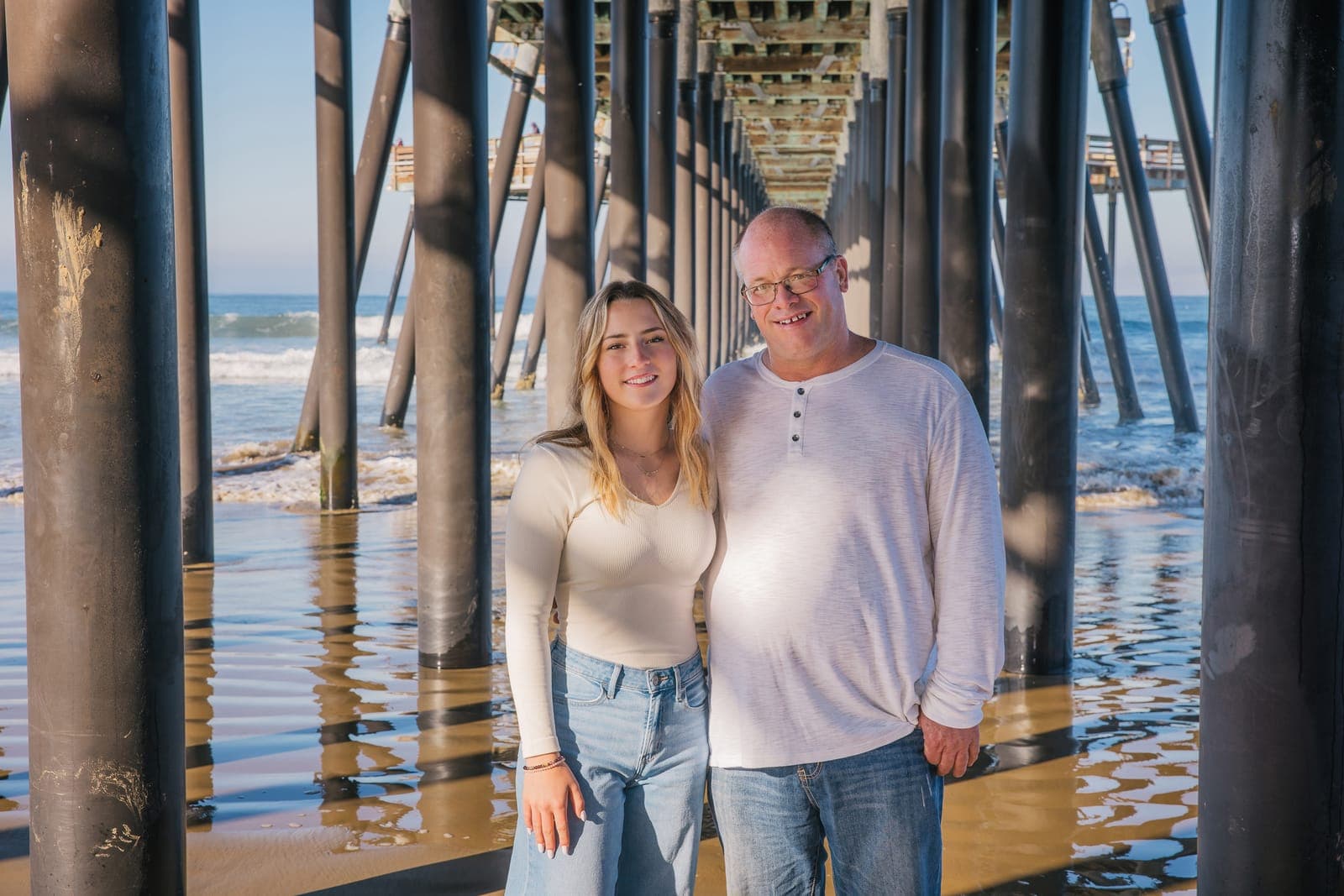
Why I Point the Camera Into the Sun
At the beach the sun sets over open water, which means the prettiest light in the frame is behind your family and pointed straight at me. New clients sometimes assume that is a mistake. It is the entire plan.
Turning a family to face into low sun gives you squinting, hard shadows under eyes and noses, and children who physically cannot keep their eyes open. Turning them away from it gives you a rim of warm light around hair and shoulders, soft open shade on every face, and a background of lit water. The trade is that I have to expose for the faces and manage the flare rather than letting the camera average the scene — which is precisely the part a phone struggles with at the beach, and why so many beach snapshots come back as silhouettes against a blown-out white sky. I cover that gap in more detail in my comparison of a professional photographer versus an iPhone.
The practical consequence for you is simple: when I ask your family to stand with your backs to the water and the sunset, that is not me wasting the view. The view is in the photograph. It is just behind you, glowing.
What Sand and Salt Do to Clothes and Feet
Build the palette first — my guide to what to wear for family photos covers coordinating without matching. What follows is the layer that only applies on sand.
Choose fabrics that move. There is nearly always some breeze here, and light, flowing cloth turns it into an asset — a skirt with shape in it, sleeves that lift. Stiff, structured garments just flap and crease. Then watch your hemlines: anything long trails in wet sand, and a damp sandy hem stays visibly damp and sandy for the rest of the session. If someone is wearing a maxi dress, they are the person who gets photographed slightly higher up the beach.
Be careful with pure white. Bright sand already bounces a great deal of light back up into faces, which is flattering, but white clothing against pale sand in bright sun loses its edges and the shape of the garment disappears. Soft neutrals, warm earth tones, and the blues and greens that sit naturally against water all hold up better.
Go barefoot. It is the right look, it solves shoes filling with sand, and it lets everyone walk at the water's edge where the light and the reflection both are. Roll trousers to mid-calf before we start rather than hitching them up as you go, so the line stays even in every frame. Bring a bag for the sandy shoes and a towel for feet afterward — dry sand brushes off, wet sand does not.
Decide About the Water Before You Arrive
Every family with young children faces the same question at a beach session, and the families who answer it in the car do much better than the families who answer it by accident at minute ten.
There are two good answers. If the plan is dry, we work above the wet line, photograph the water as a background, and nobody is told off for being near it. If the plan is that the children go in, we photograph every grouping that needs clean, dry clothes first — the whole family, the parents, the siblings — and then let them in at the end. Those last frames are regularly the best of the session, because a child who has just been granted permission to run into the Pacific has completely stopped thinking about the camera. That is the expression you cannot direct.
The bad answer is no answer, because then a four-year-old makes the decision for you at the wrong moment and everything after that is photographed in wet clothes. Tell me which it is when we plan the session and I will build the running order around it. For the rest of the groundwork with young children — sleep, food, timing, what to tell them — my guide to how to prepare kids for family photos covers it, and if the dog is coming, family photos with dogs has the beach leash rules by location and hour.
Sun at the Beach Is Not Sun Anywhere Else
You are not only getting the sun above you; you are getting a second helping off the ground. The World Health Organization puts numbers on it: “grass, soil or water reflect less than 10 per cent of incident UV radiation, sand reflects about 15 per cent, and sea foam about 25 per cent.” A session on sand next to breaking surf is a materially higher UV environment than the same hour on a lawn.
The counterintuitive part is the fog. A soft gray marine-layer afternoon feels like a day you can skip the sunscreen, and the WHO is explicit that this is wrong: “light or thin clouds have little effect and may even enhance UV levels because of scattering.” Put it on anyway, and reapply at the beach rather than at home before the drive.
This is a further quiet argument for the late slot. UV is highest in the hours around solar noon, so an hour-before-sunset session is gentler on everyone's skin as well as being the calmest and best-lit part of the day.
One Note About Where You Stand
Not every stretch of sand on this coast is a pedestrian beach. Oceano Dunes State Vehicular Recreation Area allows street-legal and off-highway vehicles on the sand, and California State Parks marks the boundary plainly: “Post 2 is one mile south on the beach from Pier Avenue and marks the beginning of the OHV area.”
It is a genuinely striking landscape and I do photograph there, but it is not the place to let a toddler run freely, and it is not where I would put a session with small children by default. The beaches at Pismo Beach and Avila Beach carry no vehicle traffic and are where most of my family beach work happens.
What to Pack
Beach-specific, on top of the usual. It lives in the car and comes out between setups.
- A towel per child, and one spare
- A bag for sandy shoes, and a second for wet clothes
- A brush and spare hair ties — the wind will win at some point
- Water, and a snack that will not melt or stain
- Sunscreen, reapplied at the beach rather than before you leave home
- A change of clothes for anybody who is going near the water
- A light layer each for after sunset, when it drops cold quickly here
That last one catches people out. The temperature here falls quickly once the sun is off the water, and the best frames of a beach session often happen in the fifteen minutes after sunset, when the sky still has color in it and the light has gone soft and blue. A family who is cold will not want to stay for them.
If the forecast is genuinely against us — real wind, real rain — we move the date or move indoors to my Grover Beach studio. Gray skies are not a reason to reschedule. A twenty-five-mile-an-hour onshore wind with a two-year-old is.
Sources
- NOAA Tides & Currents — Datums for Station 9412110, Port San Luis, CA (1983–2001 tidal datum epoch; mean higher-high water 9.58 ft and mean lower-low water 4.25 ft on the station datum, a spread of 5.33 ft; mean high water 8.87 ft and mean low water 5.29 ft, a mean range of tide of 3.58 ft — values read from the NOAA CO-OPS datums API for this station)
- University of British Columbia, ATSC 113 — Local Winds (Sea Breeze) (“the sea breeze is strongest mid-day through mid-afternoon local time”; “the sea-breeze can die in the late evening BEFORE the sun sets”; coastal near-surface speeds of “4 to 40 km/h (=1 to 10 m/s) with typical values of about 22 km/h (=6 m/s)”)
- World Health Organization — Radiation: Ultraviolet (UV) (“grass, soil or water reflect less than 10 per cent of incident UV radiation, sand reflects about 15 per cent, and sea foam about 25 per cent”; “light or thin clouds have little effect and may even enhance UV levels because of scattering”; UV levels are highest “during the 4-hour period around solar noon”)
- California State Parks, Off-Highway Motor Vehicle Recreation — Oceano Dunes SVRA (“Post 2 is one mile south on the beach from Pier Avenue and marks the beginning of the OHV area”; fenced and signed areas are closed to vehicular use)