
Headshots & Branding
Indoor vs. Outdoor Headshots
Most people decide this question on taste — studio light looks serious, afternoon light looks warm — and then live with the consequences for three years. Taste is the least useful way in. There are three practical questions that actually settle it, and almost nobody asks them before the session. Here they are, along with an honest account of what each option costs you.

The Short Answer
Choose a studio headshot when the picture has to sit beside other people’s headshots, survive being shrunk to the size of a postage stamp, or be matched again a year from now. Choose an outdoor or on-location headshot when the picture’s job is to show context — where you work, what you work with, or that you are genuinely here rather than anywhere. Those are different jobs, and most professionals need both, which is why I usually photograph both in one sitting.
Everything below is the reasoning behind that, in the order I actually work through it with a client.
Side by Side
| Factor | Studio / indoors | Outdoors / on location |
|---|---|---|
| The light | Built, measured, and identical from the first frame to the last | Borrowed from the sky, and changing while you stand there |
| The background | Chosen — a tone, a depth, an amount of blur | Whatever is behind you, and whoever walks through it |
| What it says | Formal, credentialed, consistent | Approachable, in context, visibly local |
| Weather risk | None. The date holds. | Real. Wind, fog, and heat all get a vote. |
| At thumbnail size | Survives it — the frame is already a face | Loses the background that justified shooting outside |
| Matching it later | Repeatable months or years from now | That afternoon's light is not coming back |
| Where it happens | The Grover Beach studio, or lights brought to your office | Your site, a street, a field, a shoreline |
| Best for | Rosters, directories, boards, any page with a grid on it | Websites, About pages, press, trades, growers, agents |
Question One: What Will It Sit Next To?
This is the question that decides it most often, and it is almost never asked. A headshot is rarely looked at on its own. It appears in a row of partners, a brokerage roster, a board page, a conference speaker grid, a directory of practitioners. The moment it is in a grid, it stops being judged on its own merits and starts being judged on whether it belongs.
A beautiful outdoor headshot dropped into a column of plain studio portraits does not read as the best picture on the page. It reads as the one that was taken somewhere else. The background tone is warmer, the light comes from a different direction, the head is a different size in the frame, and the eye catches all three before it gets anywhere near your face. The reverse is just as true: one tightly cropped studio frame in a page of environmental portraits looks like a stock photo somebody dropped in to fill a gap.
So the first thing I ask is where the picture is going to live. If the answer is “next to eleven other people,” the existing set makes the decision for you — and if the set does not exist yet, build it deliberately. How a matched set gets made is the whole subject of my page on team headshots for small businesses, which covers holding the light, background, and crop constant across a staff, including the people you have not hired yet.
Question Two: How Small Will It Be?
The second question is about size, and it is where outdoor headshots quietly fail. A great many of the places a headshot lands display it tiny and round: a profile photo, a comment avatar, an email signature, a byline, a speaker thumbnail. A circular crop takes the corners off a square, which means the usable area is smaller again.
Think about what that does to each kind of picture. A studio headshot is already a face filling a frame, so shrinking it costs you detail and nothing else — it still reads instantly. An environmental portrait is a face inside a scene, and the scene is the entire reason it was shot outside. Crop to a circle around the head and the vineyard, the storefront, the ocean behind you are gone. You are left with a smaller, softer, more distant version of a studio headshot, taken at considerably more trouble.
This is not an argument against outdoor headshots. It is an argument for knowing which file goes where, and for shooting a tight frame while you are out there so you have one. When I plan a session I ask what the images have to do before I decide where to stand, because the intended use changes the crop I shoot for.
Question Three: Will You Need to Match It Again?
A studio setup is a recipe. The same lights, in the same places, at the same power, against the same background produce the same picture in March that they produced in September. That is an unglamorous property, and for any organization with turnover it is the deciding one. Somebody joins in the spring, they sit in the same chair, and the team page absorbs them without a visible seam.
Outdoor light is not a recipe. The particular combination of haze, sun angle, and sky that made your picture work on a Thursday in October is not available to order. You can return to the same spot at the same hour and get a usefully similar frame, but “usefully similar” and “matching” are different standards, and a grid holds you to the second one.
If you are a sole practitioner and the picture only ever appears on its own, none of this matters and you should shoot wherever you look most like yourself. If there is any chance of a second person, a second round, or a replacement in two years, that is a strong argument for building the repeatable version first.
What a Studio Headshot Actually Buys You
- The light is the same for frame one and frame ninety, which is what makes a set of pictures look like a set.
- You pick the background instead of negotiating with it — tone, depth, and how much of it is there at all.
- Nothing is behind you except what you put there. No passers-by, no parked cars, no leaf blower starting up.
- It works at nine in the morning in February, which matters when the session has to fit a real calendar.
- It is repeatable, which is what makes an existing set extendable rather than something you redo from scratch.
- A tight, clean frame is what directories, conference programs, and profile photos are actually asking for.
The honest cost: a studio headshot looks like a studio headshot. The background is a decision, not a place, and it tells your audience nothing about you beyond the fact that you took this seriously enough to sit for it. For some professions that is exactly the message. For others it is a missed opportunity, and a gray background is the visual equivalent of a resume with no cover letter.
What an Outdoor Headshot Actually Buys You
- Context does an enormous amount of work. A grower in the field and a broker on their own street are both making a claim a gray background cannot make.
- Natural light on a soft morning is genuinely beautiful, and people who dread being photographed usually relax faster outside.
- It places you somewhere. For a business that trades on being local, the Central Coast behind you is not decoration — it is the point.
- There is room to move. Walking, leaning, working, and talking all produce expressions a stool in a studio does not.
- You get wider frames as well as tight ones — website headers, section breaks, and social posts that a headshot crop cannot fill.
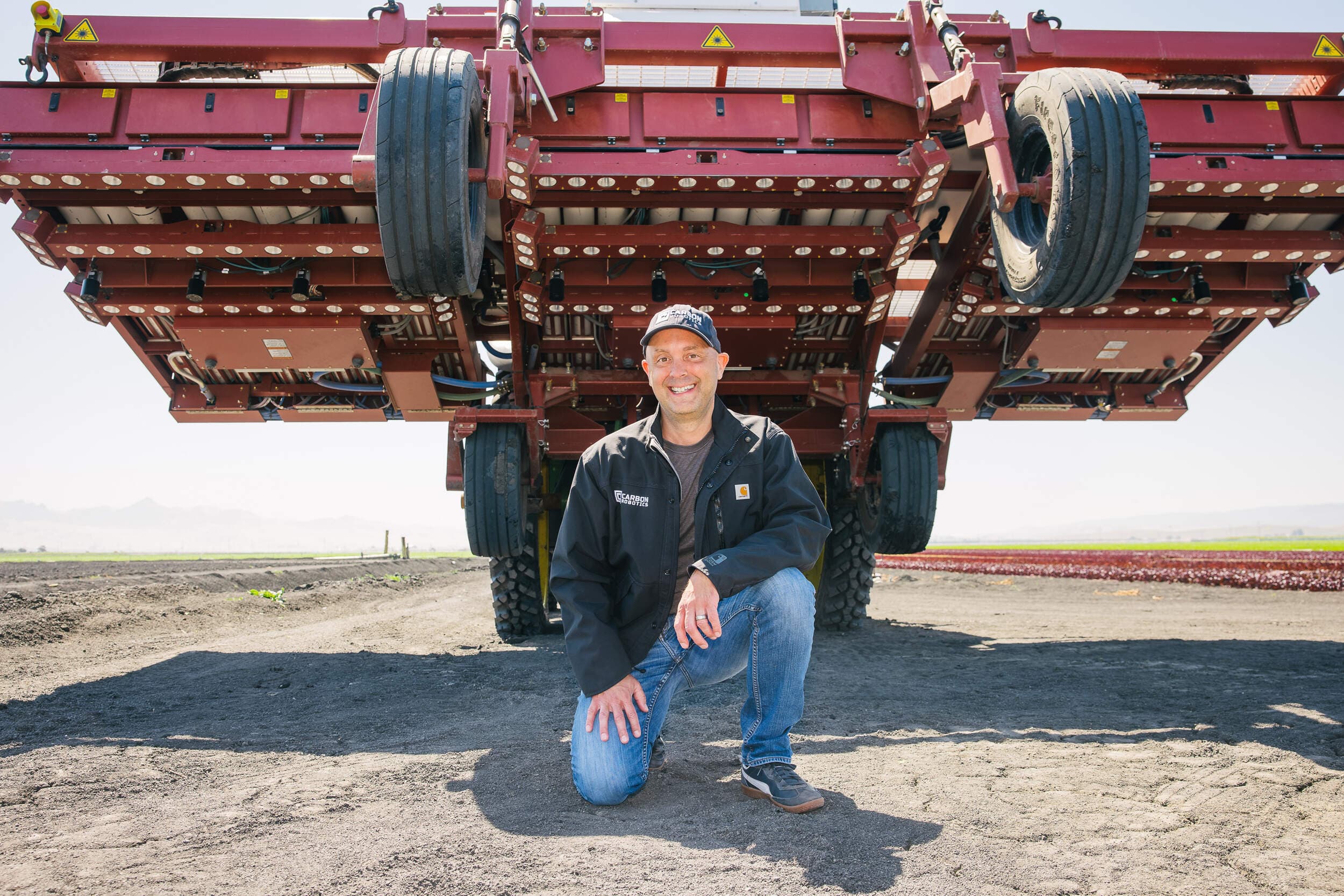
- It is the only way to photograph the thing you actually do, if what you do does not happen in an office.
The honest cost is a list of small risks that each have a decent chance of being fine and a real chance of not being. Wind rearranges hair between frames. Clear midday sun puts shadows in eye sockets and makes everybody squint, which is why outdoor sessions want early morning, late afternoon, or an even overcast — my guide to the best time of year for outdoor photos has the month-by-month version for this coast. A date can be lost to weather and has to be found again. And there is one more cost that nobody anticipates.
The Part Nobody Plans For: Permission
A headshot for your business is commercial photography, and on public land that distinction has paperwork attached to it. This is my job to handle rather than yours, but it is worth knowing because it is the real reason a location gets chosen weeks ahead rather than on the morning of.
California State Parks states plainly that it “requires an approved film permit for all commercial still photography, professional photographers offering services, student photo/film, and professional development projects on State Park property,” that commercial photography there is “allowed on a case by case basis by advance arrangement,” and that a permit is needed by “anyone engaged in commercial (profit and sale) photography on state property.” Insurance is collected by the California Film Commission, and the department asks applicants to start the process “at least 7-10 days prior.” Pismo State Beach is state park property. So is a good deal of the shoreline people picture when they imagine an outdoor session here.
County land has its own rules and its own numbers. San Luis Obispo County’s Real Property Services issues permits for “still photos of and on County-owned or County-maintained roads, parks, real property, and facilities,” requires “a minimum 10 business days’ notice,” and charges a $250 non-refundable application fee plus a $450 permit fee for filming up to seven consecutive days, with a certificate of insurance naming the county as additional insured at $2 million limits. Film SLO CAL, the county film office, puts the general situation well: “Each jurisdiction in San Luis Obispo County has its own special permitting requirements,” and asks for “at least five to seven business days at a minimum for most permits to process.” Cal Poly, Caltrans, and the harbor district each handle their own.
The practical upshot is simple. Your own property is the easiest outdoor location there is — your lot, your yard, your storefront, your field — and Film SLO CAL notes that “most cities in San Luis Obispo County do not require filming permits on private property.” After that comes the studio, where the only calendar that matters is ours. Public land is entirely workable and often worth it; it just is not a spontaneous decision.
How I Would Choose
Running the three questions against the situations I see most often on the Central Coast:
- 1Your picture is going on a page with your colleagues' pictures: match whatever that set already is. The set wins.
- 2You are in law, finance, medicine, or on a board: studio. These are fields where the audience expects a plain background, and a beach behind you reads as a different kind of business.
- 3You sell real estate: both, and plan the crops in advance — a roster, a sign rider, and a flyer all want different shapes out of the same sitting.
- 4You are a tradesperson, a grower, a maker, or a trainer: on location, where the work is. The context is most of the credibility.
- 5You are a consultant or a solo professional whose whole website is you: lead with one clean headshot and fill the rest of the site with environmental frames.
- 6You need the picture for a specific deadline that cannot move: studio. Weather has sunk more deadlines than anything else on this list.
- 7You genuinely hate being photographed: outside, late in the day, moving. It is the version of this that feels least like a dental appointment.
Why Most People End Up With Both
The question in the title is a genuine one, but it is not usually an either/or in practice. The two pictures are doing different work. One is an identification — this is my face, here it is clearly, put it wherever faces go. The other is an argument — this is who I am and where I do it. Asking a single photograph to carry both is how people end up with an image that is slightly wrong everywhere it appears.
So a branding session here is usually a combination, and planning it that way costs very little extra: a clean headshot setup for the profile and the roster, then environmental frames in your space for the website, the About page, and anything with room for a wider picture. If you want the fuller version of what a branding library contains and how it differs from a single headshot, my guide to what branding photography is covers it. If you have already booked and want to arrive ready, my headshot session preparation guide covers wardrobe, grooming timing, and the day before. Agents juggling a roster photo, a sign rider, and a flyer should start with real estate agent headshots, and the headshots and branding photography page is the overview of all of it.
Either way, tell me where the picture is going before we decide where to stand. That one sentence changes more about the result than the location does.
Sources
- California State Parks — Photography & Film Information (“California State Parks requires an approved film permit for all commercial still photography, professional photographers offering services, student photo/film, and professional development projects on State Park property”; “Commercial photography is allowed on a case by case basis by advance arrangement”; a permit is required by “anyone engaged in commercial (profit and sale) photography on state property”; “Yes, the California Film Commission collects insurance from applicants”; applicants should apply “well in advance of any desired filming event (at least 7-10 days prior)”)
- County of San Luis Obispo, Real Property Services — County Property Film Permits (issues permits for “still photos of and on County-owned or County-maintained roads, parks, real property, and facilities”; “We require a minimum 10 business days’ notice in order to process your application”; “pay the $250 non-refundable application fee”; “A $450.00 Film Permit fee for filming up to seven consecutive days”; “Certificate of Insurance naming the County of San Luis Obispo, its officers and employees as additional insured with $2 million limits”)
- Film SLO CAL — Film Permits (“Each jurisdiction in San Luis Obispo County has its own special permitting requirements”; “Most cities in San Luis Obispo County do not require filming permits on private property”; “Please allow at least five to seven business days at a minimum for most permits to process”; separate contacts listed for state parks, Cal Poly, Caltrans, and the Port San Luis Harbor District)