
Senior Portraits
Senior Pictures With Your Car
You saved two summers for it, or your grandfather handed you the keys, or you and your dad spent a year getting it to run. Whichever one it is, the car is not a prop somebody thought of on the way to the session — it is a real piece of what your senior year actually looked like. Cars photograph beautifully and cars photograph badly, and the difference is almost never the car. It is the wash, the light, the angle, and whether we had permission to be parked where we were parked. Here is how I plan these sessions.
The Short Version
Everything below is explained properly further down. If your session is this week, this is the whole thing in eight lines.
- 1Decide early whether the car is the set or the background. It changes the location, the light and the running order.
- 2Wash and dry it one to two days ahead, not on the way. Water spots photograph.
- 3Clean the glass on both sides and empty the interior completely. If we open a door, the inside is in the picture.
- 4Aim for soft light or full dark. Hard midday sun on paint is the hardest version of this session.
- 5Have permission for wherever we park. A lot has an owner, and a park lawn is not a road.
- 6Do not wear the color of your paint. You will merge with the biggest object in the frame.
- 7Plan the yearbook frame separately. The car cannot be in it.
- 8Engine off, parking brake on, wheels straight — in every single frame.
Is the Car the Set, or the Background?
This is the first question, and it decides almost everything else. In the first version, the car is the set. We build the concept around it — a showroom floor, a downtown block after dark, a ranch road with the tailgate down — and the car gets lit and framed the way an advertisement would light and frame it. That is a concept session, and I write about how those get built in my guide to editorial and creative senior pictures.
In the second version, the car is the background. It sits behind you, parked where it always parks, doing what a letterman jacket or a guitar case does in a portrait — telling the truth about you without taking over. That version needs far less planning and often lands closer to what families actually frame later.
Be honest about the quantity, too. Almost nobody wants a whole session of car pictures. What most seniors want is six or eight very good frames with the car, inside a session that is otherwise about them. A senior session here runs about one and a half to two hours, and the car realistically earns twenty to thirty minutes of that. Planning for twenty-five minutes is how you get twenty-five good minutes.
Wash It Two Days Early, Not on the Way
A portrait lens wide open is unkind to a car. It resolves water spots, swirl marks in the clear coat, pollen sitting in the panel gaps and bug residue across the nose, and none of that comes out quickly in retouching the way a stray hair does. Wash and dry the car a day or two before the session so it has time to dry completely and so you are not arriving flustered with a wet car and a towel.
Glass matters more than paint. We see through the windshield and the side windows in almost every three-quarter angle, so clean the inside of the glass as well as the outside — the inside is the half that hazes. Then empty the interior completely: the gym bag, the parking pass hanging off the mirror, the cup in the door pocket, the sticker on the rear glass you stopped noticing in sophomore year. If we open a door, the interior is in the photograph.
Two smaller things that make a real difference. Dress the tires matte rather than wet-look glossy, because high-gloss tire shine flares in sunlight and flings onto the paint the first time you move the car. And bring one clean microfiber towel and a bottle of detail spray in the trunk, so we can take ten minutes at the location and lift the dust the drive put back on.
If your car is black or any dark color, give it more time than you think. Dark paint is the most beautiful thing to photograph and the least forgiving — it shows every swirl and it mirrors every single thing around it. White and silver cars forgive almost everything.
A Car Is a Mirror, Not a Wall
Here is the one idea that changes how you think about these pictures. Paint is a curved mirror. It barely has a tone of its own in a photograph — what it shows is whatever happens to be in front of it: the sky, the building across the street, a palm tree, the yellow truck parked two spaces over, and me. Which means the location is not just a backdrop here. It is the lighting.
That makes the Central Coast marine layer a genuine asset rather than the weather we apologize for. A high even overcast is a softbox the size of the sky, and it lays one long clean highlight down the body instead of fifty broken ones. The hour before sunset is the other reliable window, raking warm light along the side of the car and giving the paint some depth. Hard midday sun is the difficult version: the roof blows out, the chrome and the glass flare, and every reflection in the clear coat arrives in sharp focus.
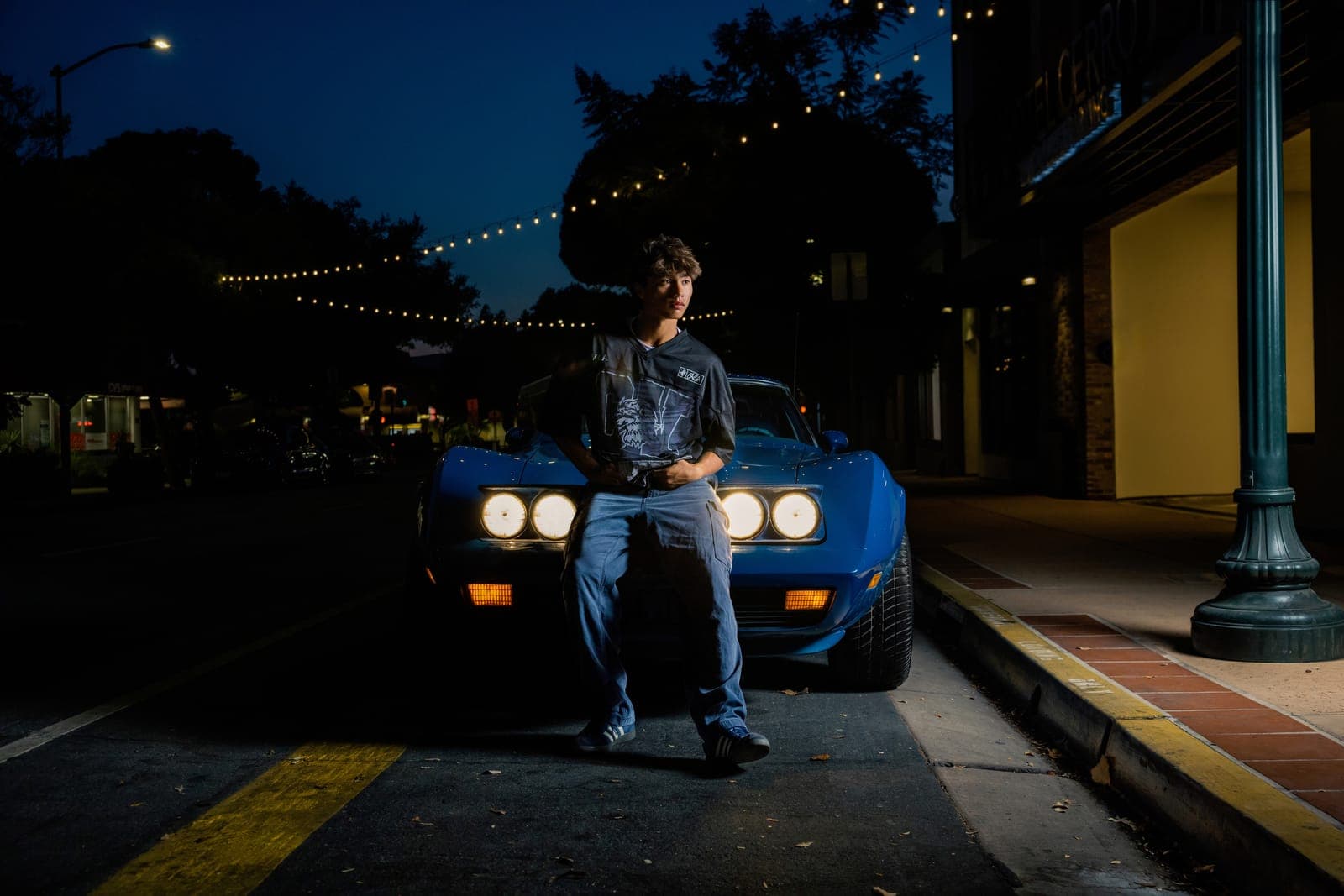
Then there is night, which is my favorite way to do this. After dark the car stops reflecting the entire sky and starts reflecting only what we choose to put in front of it. We turn the headlights on and let them work as a practical light inside the frame, light you with flash, and let a downtown block go deep blue behind you. A circular polarizer is the other tool I reach for constantly — it takes the reflection out of the windshield when I want to see you through the glass, and it comes straight back off when I want the sunset laid across the hood.
Where You Can Actually Park It
This is the part that quietly derails car sessions, and it is the part I handle before your date rather than on it. Private property is where most of these sessions land, because somebody with authority can simply say yes — a dealership lot, a friend’s shop, a ranch drive, a winery’s gravel yard. Film SLO CAL, the county film commission, notes that most cities in San Luis Obispo County do not require filming permits on private property. I still get that yes in writing ahead of time, because “my uncle works there” is not the same as permission.
Public property has an actual statute behind it. California Vehicle Code section 21113 says a person shall not drive a vehicle, or stop, park or leave one standing, on the driveways, paths, parking facilities or grounds of a public school, a unit of the state park system, a county park, or property under the direct control of a city, except with the permission of the governing body and subject to whatever conditions it sets. In plain terms: the pretty lawn, the campus quad and the county park green are not places to drive a car onto for a photograph. They are places to ask about first.
City streets and public lots sit in between, and several jurisdictions here permit commercial photography on city property. Film SLO CAL asks for at least five to seven business days for most permits to process, which is why the car conversation belongs at the consultation and not in the parking lot. My guide to the best photo locations in San Luis Obispo goes through which spots need paperwork and which do not.
And the question every senior asks: no, we cannot drive it onto Pismo or Avila. The only place on the Central Coast where a street-registered car can legally be driven on the sand is Oceano Dunes State Vehicular Recreation Area, where vehicle day use runs 7 a.m. to 10 p.m. for a $5 vehicle fee, all vehicles must be registered through the DMV and display current registration, the entrances are at the end of Grand Avenue in Grover Beach and Pier Avenue in Oceano, and fenced and signed areas are closed to vehicles entirely. It is also soft sand and salt air, which is a real decision for a car you have put money into. I will tell you honestly whether yours belongs out there.
The Angles That Make a Car Look Like a Car
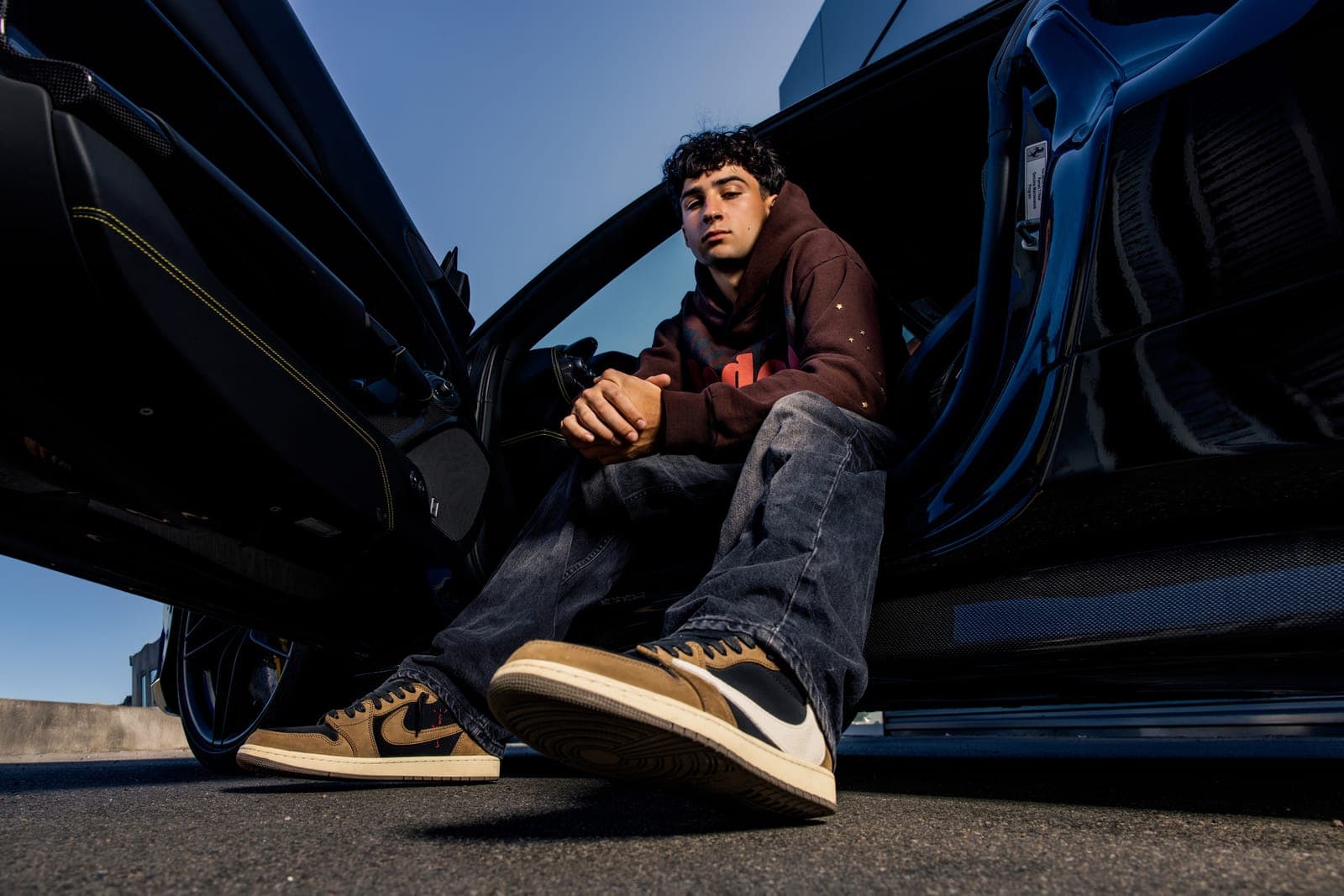
Get low. This is the single biggest difference between a snapshot and a portrait when a car is involved. A car photographed from standing height looks like a car in a parking lot, because that is the view everyone has of it every day. A car photographed from around headlight height or below looks like the car you think you own. The hero photograph at the top of this page was made with the camera practically on the asphalt.
The three-quarter front is the angle everybody recognizes, because it shows the face of the car and one full side at the same time. Turn the front wheels slightly toward the camera for it, so the face of the wheel shows instead of the thin edge of the tire. For a dead straight-on frame, point the wheels straight — a crooked wheel in a symmetrical shot reads as a mistake.
Then stop photographing the whole car. The frames families end up printing from these sessions are almost always the close ones: your hand on the wheel with the class ring on it, the keys, your reflection in the door, the badge on the fender, you and your best friend seen through the windshield. A car fills a frame fast, and if it takes up two-thirds of every picture we have made a car advertisement rather than a senior portrait.
What to Wear Next to Your Paint
The car is the largest block of color in the picture, so it is part of your palette whether you planned it that way or not. The one rule worth keeping is simple: do not wear your car’s color. A red shirt against red paint flattens you into the bodywork, and head-to-toe black against black paint does the same thing in the other direction.
Beyond that, warm paint likes cool neutrals and cool paint likes warm ones. A red or orange car works beautifully with denim, cream, gray and white. A blue or silver car can take rust, olive, camel and black. A black car will take almost any real color, as long as it is a color.
Bring at least one look that has nothing to do with the car, so we are not locked into a single mood for the whole session. My guide to senior picture outfit ideas covers how to build those looks, and what to bring to a senior photo shoot is the full packing list for the day itself.
The Car Is Not in Your Yearbook Photo
Worth knowing before you plan the day around the car. Walsworth, one of the major yearbook publishers, tells students to be photographed “from the chest up, no hands visible in the picture,” standing “in front of a blank, one-color wall,” with “No props or miscellaneous objects” and “No additional people or pets in the photo, besides the student.” A car manages to be a prop, a background and an object all at once, and your own school will have its own version of those rules on top.
So we shoot one deliberately plain yearbook-safe look as its own setup, early, while everything is still fresh, and then we go make the pictures you actually came for. That split is the whole strategy, and I lay it out properly in school photos vs. professional senior portraits.
Two Rules I Do Not Bend
The car does not move while we are photographing it. Engine off, parking brake on, in park or in gear, every frame. No rolling shots, nobody pulling forward a few feet while I shoot, nobody sitting on a running car. A photograph is never worth the version of this that goes wrong.
And we do not work in a live traffic lane — not a shoulder, not a median, not the mouth of a parking lot. If the only good frame is in moving traffic, it is not a frame. There is a third one I will mention gently: nobody sits on the hood, roof or trunk lid unless whoever owns the car is standing right there saying yes, because a dented hood is not a thing you discover until the light hits it a week later.
Tell Me at the Consultation
Every one of these decisions is easier a month out than an hour out. Tell me the car is coming when we first talk, send me a picture of it, and tell me what it means to you — whether it is the truck your family has had since before you were born or the thing you bought with two summers of paychecks. That changes which locations I suggest, how early I start asking for permission, what time we begin, and what I bring.
If you are still working out the calendar, when to book senior photos works backward from local yearbook deadlines, and the experience page walks through how a session runs from the first conversation to the reveal. Bringing the dog as well as the car is a very normal request, and senior pictures with your dog covers how that half of the day works.
Sources
- California Vehicle Code § 21113 (a person “shall not drive a vehicle or animal,” or stop, park or leave one standing, on the driveways, paths, parking facilities or grounds of listed public property — including public schools, units of the state park system, county parks and property under the direct control of a municipal legislative body — except “with the permission of, and upon and subject to any condition or regulation” imposed by the governing body)
- California State Parks OHMVR Division — Oceano Dunes State Vehicular Recreation Area (“Vehicle Day Use: 7am – 10pm”; “Vehicle Day Use: $5.00”; “All vehicles must be registered through the Department of Motor Vehicles and display current registration”; day-use passes sold at the beach entry kiosks at Grand Avenue and Pier Avenue; fenced and signed areas closed to vehicles)
- Film SLO CAL — Film Permits (“Each jurisdiction in San Luis Obispo County has its own special permitting requirements”; “Most cities in San Luis Obispo County do not require filming permits on private property”; “Please allow at least five to seven business days at a minimum for most permits to process”)
- Walsworth Yearbooks — Senior Portrait Help (“Make sure the photo is from the chest up, no hands visible in the picture”; “Stand in front of a blank, one-color wall”; “No props or miscellaneous objects”; “No additional people or pets in the photo, besides the student”)